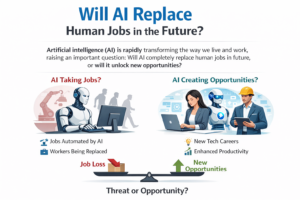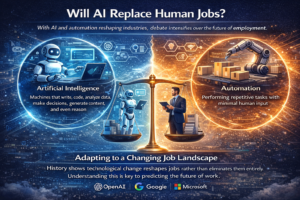
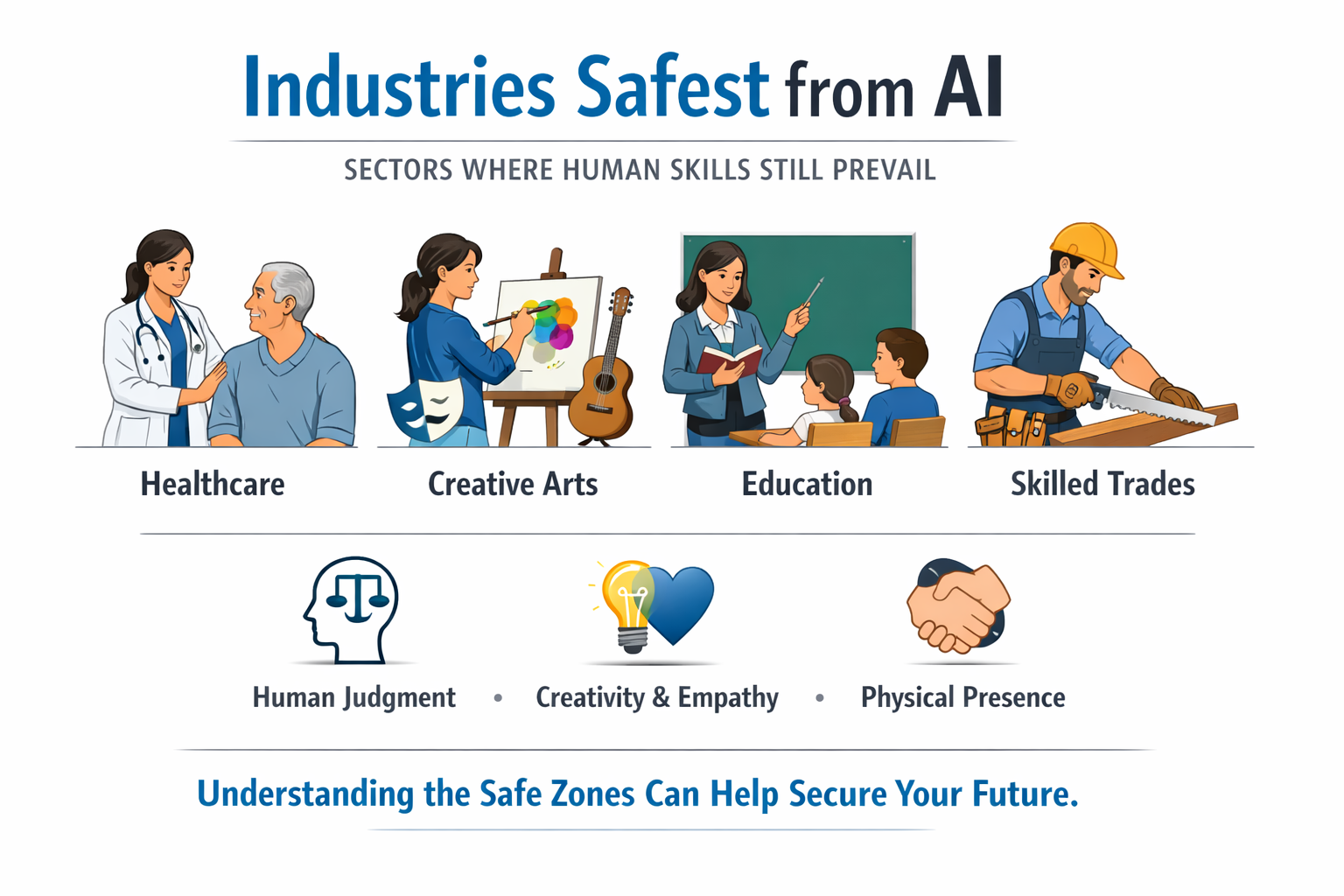
Artificial Intelligence (AI) is transforming industries at lightning speed. From automated chatbots to self-driving vehicles, AI is reshaping how businesses operate. Naturally, this raises an important question: Which industries are safest from AI?
According to research from the World Economic Forum (https://www.weforum.org/), automation will both eliminate and create millions of jobs. However, not all industries are equally affected. Some sectors rely heavily on human judgment, creativity, empathy, and physical presence—qualities that AI still struggles to replicate.
So, if you’re planning your career or protecting your business, understanding which industries are safest from AI isn’t just interesting—it’s essential.
Why Some Industries Are More Resistant to AI
Before diving into the list, let’s understand what makes certain industries safer from automation.
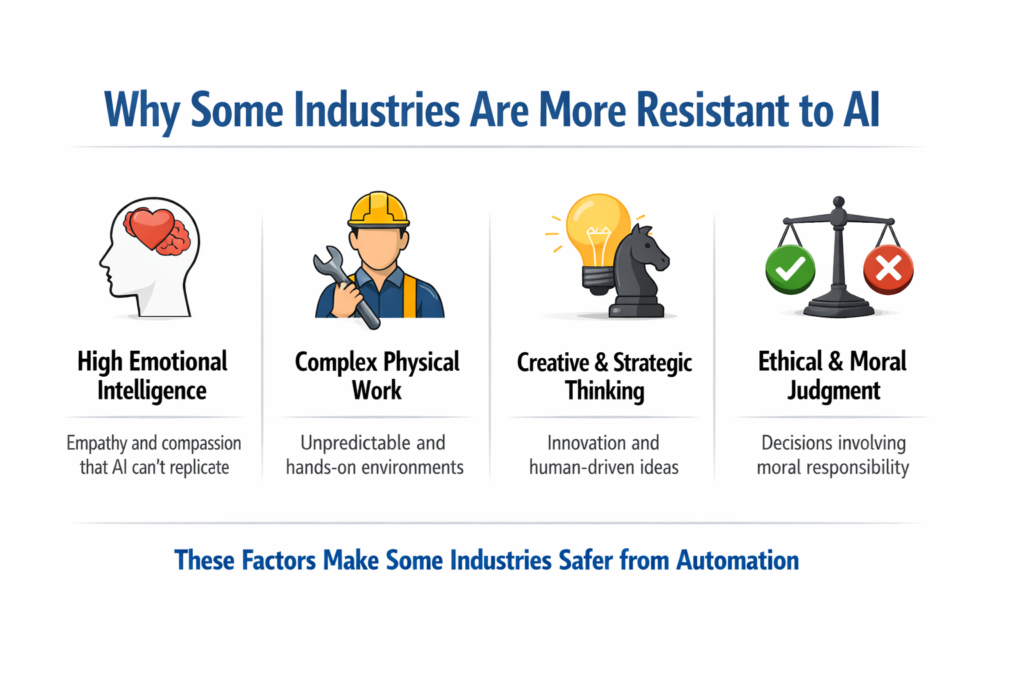
1. High Emotional Intelligence
AI can analyze data, but it can’t genuinely feel empathy. Roles requiring compassion and emotional understanding are harder to automate.
2. Complex Physical Work
Jobs involving unpredictable physical environments are difficult for machines.
3. Creative and Strategic Thinking
AI can generate content, but groundbreaking ideas still come from humans.
4. Ethical and Moral Judgment
Decision-making involving moral responsibility remains deeply human.
These factors help explain which industries are safest from AI and why they’re likely to stay resilient.
Which Industries Are Safest from AI?
Now let’s explore the 17 powerful and future-proof sectors where human skills remain essential.
1. Healthcare and Medical Care
Healthcare consistently ranks high when discussing which industries are safest from AI.
Doctors, nurses, and surgeons don’t just diagnose conditions—they comfort patients, interpret complex symptoms, and make ethical decisions. While AI assists with diagnostics and data analysis, it can’t replace bedside manners or surgical precision in unpredictable situations.
Subfields that are especially secure include:
- Emergency medicine
- Pediatric care
- Geriatric care
- Nursing
Human trust is central to healthcare. Patients want reassurance from another human being—not just a machine.
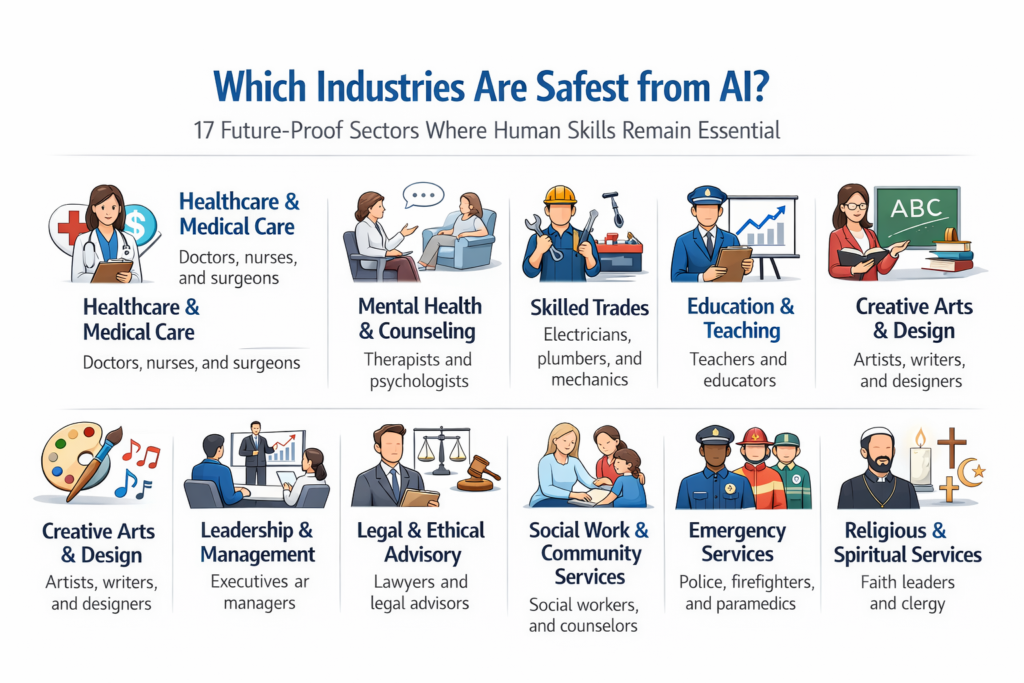
2. Mental Health and Counseling
Therapists and psychologists rely heavily on emotional intelligence. AI chatbots can simulate conversation, but they lack genuine empathy and lived experience.
When people face trauma, anxiety, or depression, they seek human understanding. That emotional connection makes this one of the strongest answers to which industries are safest from AI.
3. Skilled Trades
Electricians, plumbers, carpenters, and mechanics work in dynamic environments. Each job site presents new challenges.
Robots struggle in unpredictable physical spaces. Because of that, skilled trades remain highly resistant to automation.
Additionally, demand for infrastructure upgrades keeps these professions stable and profitable.
4. Education and Teaching
Education is more than delivering information. Great teachers inspire, motivate, and adapt to students’ needs.
While AI can provide tutoring tools, it can’t replace classroom leadership or mentorship. Schools depend on human role models.
Therefore, teaching continues to appear in discussions about which industries are safest from AI.
5. Creative Arts and Design
AI can generate music, art, and writing. However, authentic storytelling and cultural expression still depend on human creativity.
Creative professionals bring originality, emotion, and lived experience into their work. Industries such as filmmaking, branding, fashion design, and content strategy remain partially shielded.
That said, creatives must evolve and use AI as a tool rather than ignore it.
6. Leadership and Management
Strategic leadership involves negotiation, emotional awareness, and long-term vision.
Executives make complex decisions that impact employees, communities, and economies. AI can analyze data, but it can’t lead people.
Human trust and accountability keep leadership roles secure.
7. Legal and Ethical Advisory
Lawyers interpret laws, negotiate settlements, and provide strategic advice. Although AI can review documents quickly, final decisions require human judgment.
Ethical responsibility in legal matters cannot be fully delegated to algorithms.
8. Social Work and Community Services
Social workers help vulnerable populations navigate crises. Their roles require compassion, adaptability, and trust-building.
Because human connection is central, this remains one of the most resilient sectors.
9. Emergency Services
Police officers, firefighters, and paramedics operate in unpredictable, high-risk environments.
AI can support logistics and data analysis, but real-time crisis response depends heavily on human judgment and courage.
10. Religious and Spiritual Services
Faith leaders provide guidance, comfort, and moral leadership. Spiritual counseling depends deeply on personal connection and shared beliefs.
AI lacks the spiritual authority and authenticity that religious communities seek.
Technology-Complementary Careers
Interestingly, some of the safest paths aren’t anti-AI—they work with AI.
Examples include:
- AI Ethics Specialists
- Data Privacy Officers
- Cybersecurity Experts
- AI Trainers and Supervisors
Rather than asking only which industries are safest from AI, it’s also smart to ask how you can collaborate with it.
Industries at Higher Risk from AI
To understand safety, we must compare.
Industries at higher risk include:
| High-Risk Industry | Why It’s Vulnerable |
|---|---|
| Data Entry | Repetitive tasks |
| Manufacturing Assembly | Predictable automation |
| Basic Customer Support | AI chatbots |
| Telemarketing | Script-based work |
| Bookkeeping | Algorithm-driven |
Routine and repetitive jobs face the greatest threat.
Key Skills That Protect Your Career
If you’re worried about automation, focus on these future-proof skills:
- Emotional Intelligence
- Critical Thinking
- Adaptability
- Communication
- Complex Problem-Solving
These abilities strengthen your position in industries safest from AI.
Future Outlook: Human + AI Collaboration
The future isn’t humans versus machines. It’s humans with machines.
AI enhances productivity, reduces repetitive work, and improves data analysis. Meanwhile, humans bring empathy, ethics, and innovation.
Experts predict that many roles will transform rather than disappear. Therefore, staying adaptable is key.
Frequently Asked Questions (FAQs)
1. Which industries are safest from AI in the long term?
Healthcare, education, skilled trades, leadership, and mental health services are among the safest industries due to their reliance on emotional intelligence and complex decision-making.
2. Can AI completely replace doctors?
AI can assist doctors with diagnostics, but it cannot fully replace medical professionals who provide ethical judgment and human care.
3. Are creative jobs really safe from AI?
Creative jobs are partially protected. While AI can generate content, authentic storytelling and cultural creativity still rely on humans.
4. What jobs are most at risk from AI?
Repetitive and rule-based jobs such as data entry, telemarketing, and basic bookkeeping face higher automation risk.
5. Should students avoid technology careers?
Not at all. Technology careers that focus on AI management, cybersecurity, and ethics are growing rapidly.
6. How can I future-proof my career?
Develop emotional intelligence, leadership skills, adaptability, and technical literacy. Combining human strengths with AI tools ensures long-term stability.
Conclusion
So, which industries are safest from AI? The answer lies in sectors that depend on human emotion, creativity, ethical reasoning, and complex physical interaction.
Healthcare, education, skilled trades, leadership, social services, and creative industries remain resilient because they center on human value. While AI will continue transforming the workforce, it won’t eliminate the need for empathy, trust, and authentic human connection.
Instead of fearing automation, we should embrace collaboration. The smartest strategy isn’t running from AI—it’s learning how to work alongside it.
The future looks bright for those who adapt, grow, and focus on uniquely human strengths.