
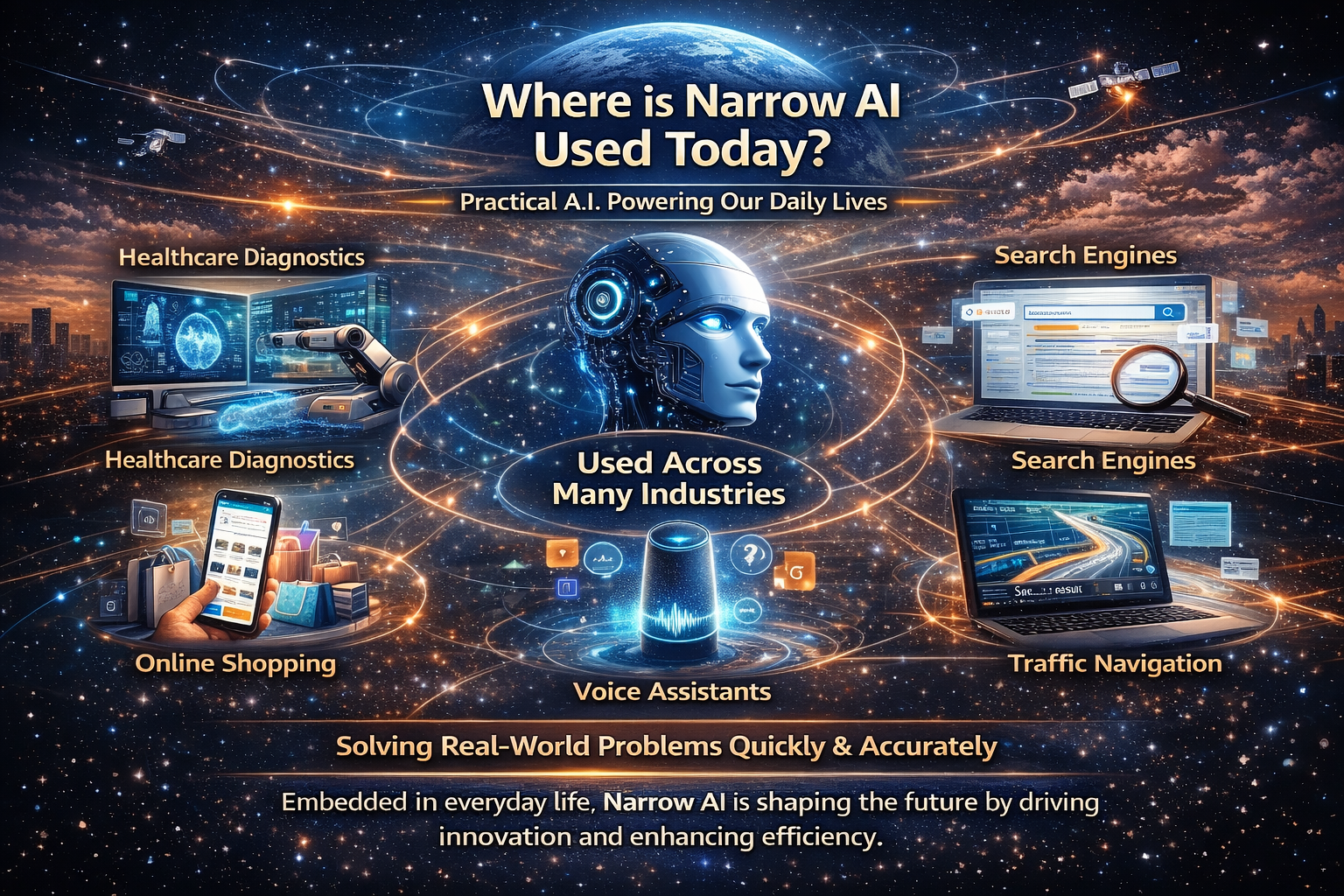
In 2026, one of the most practical and widely deployed forms of artificial intelligence is Narrow AI. When people ask where is Narrow AI used today, the answer spans almost every modern industry—from healthcare diagnostics to online shopping recommendations. Unlike general artificial intelligence, Narrow AI focuses on performing one specific task extremely well, and that focused efficiency is precisely why it has become so powerful.
You might not always notice it, yet Narrow AI quietly powers search engines, fraud alerts, voice assistants, and even traffic navigation. Because it solves real-world problems quickly and accurately, organisations across the globe continue adopting it at record speed. As a result, Narrow AI isn’t just a futuristic concept—it’s already embedded in everyday life.
Understanding its present-day applications helps us see where technology is heading next. So, let’s explore the industries, tools, and innovations that show where Narrow AI is used today and why it matters more than ever.
Understanding Narrow AI
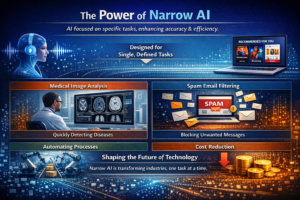
Narrow AI, sometimes called weak AI, is designed to complete a single defined task using data, algorithms, and pattern recognition. It doesn’t possess consciousness or general reasoning. Instead, it specialises.
Examples include:
- Voice assistants answering questions
- Email spam filters detecting unwanted messages
- Recommendation systems suggesting films or products
Each system performs one job with high precision, making Narrow AI extremely useful in business and daily life.
Why Narrow AI Dominates Modern Technology
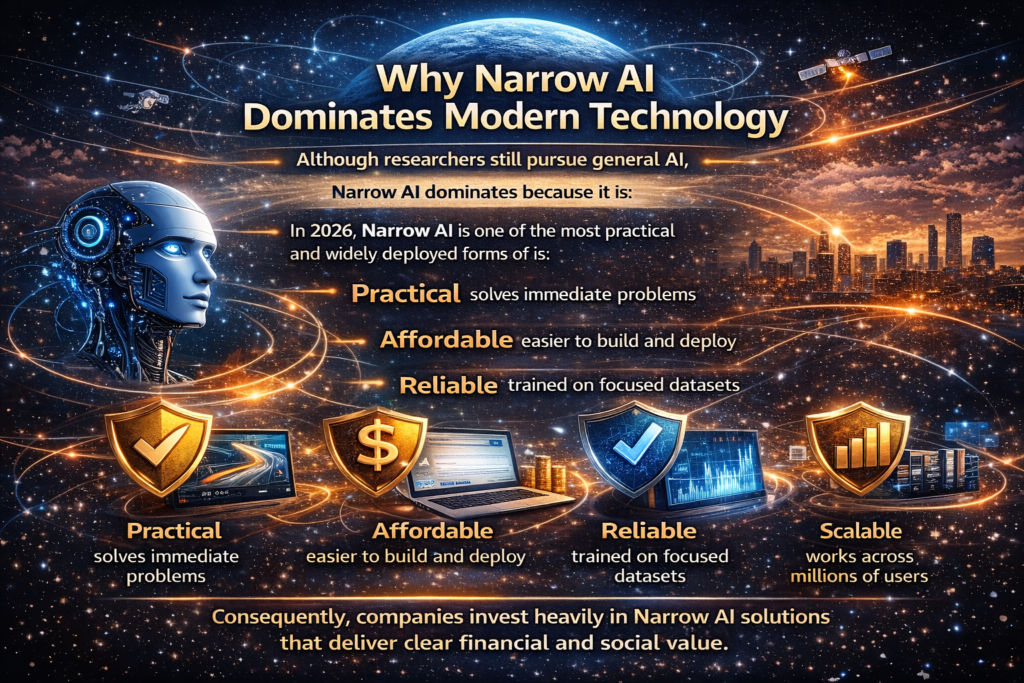
Although researchers still pursue general AI, Narrow AI dominates because it is:
- Practical – solves immediate problems
- Affordable – easier to build and deploy
- Reliable – trained on focused datasets
- Scalable – works across millions of users
Consequently, companies invest heavily in Narrow AI solutions that deliver clear financial and social value.
Healthcare Applications of Narrow AI
Healthcare clearly demonstrates where Narrow AI is used today in life-saving ways. Hospitals and clinics use AI-powered tools to analyse images, predict diseases, and support doctors.
These systems don’t replace professionals. Instead, they enhance accuracy, reduce workload, and speed up diagnosis, ultimately improving patient outcomes.
Where Is Narrow AI Used Today
Where Is Narrow AI Used Today
Where Is Narrow AI Used Today
Where Is Narrow AI Used Today
Where Is Narrow AI Used Today
Where Is Narrow AI Used Today
AI in Medical Imaging
Radiology has changed dramatically due to Narrow AI. Algorithms can now:
- Detect tumours in X-rays and MRIs
- Identify early cancer signs
- Highlight abnormalities doctors might miss
This leads to earlier treatment and higher survival rates, proving the real-world value of specialised AI.
Virtual Health Assistants
Chat-based medical assistants help patients:
- Book appointments
- Track symptoms
- Receive medication reminders
Such tools expand healthcare access, especially in remote regions.
For further reading on healthcare AI developments, see the World Health Organization’s technology overview:
https://www.who.int
Narrow AI in Finance
The financial sector adopted Narrow AI early because speed and accuracy are critical. Today it powers:
- Fraud detection systems
- Credit scoring models
- Algorithmic trading platforms
AI monitors millions of transactions instantly, flagging suspicious behaviour within seconds. Without Narrow AI, modern digital banking would struggle to remain secure.
Retail and E-commerce Transformation
Online shopping provides one of the clearest answers to where Narrow AI is used today. Every time you see:
- “Recommended for you” products
- Personalised discounts
- Chatbot customer support
—you’re interacting with Narrow AI.
These systems analyse browsing behaviour to increase satisfaction and sales simultaneously.
Education Powered by Narrow AI
Schools and universities increasingly use AI-driven platforms that:
- Adapt lessons to student ability
- Provide instant feedback
- Automate grading
This personalised learning approach helps students progress at their own pace, making education more inclusive.
Transportation and Autonomous Systems
Navigation apps, ride-sharing platforms, and self-driving technologies rely heavily on Narrow AI.
Key uses include:
- Real-time traffic prediction
- Route optimisation
- Driver-assistance safety systems
Even partially autonomous cars depend on multiple Narrow AI models working together.
Manufacturing and Industry Automation
Factories now deploy AI-enabled robots for:
- Quality inspection
- Predictive maintenance
- Assembly automation
This improves efficiency, safety, and production speed, reducing operational costs.
Cybersecurity and Threat Detection
As cyber threats grow, Narrow AI protects digital systems by:
- Detecting unusual login behaviour
- Blocking malware automatically
- Monitoring network traffic
Because attacks evolve rapidly, AI’s continuous learning capability is essential.
Entertainment and Media Personalisation
Streaming platforms and gaming companies use Narrow AI to:
- Recommend films and music
- Adjust game difficulty
- Analyse viewer engagement
This creates highly personalised experiences, keeping audiences engaged longer.
Smart Homes and IoT
Voice assistants, smart thermostats, and security cameras all demonstrate where Narrow AI is used today inside homes.
They can:
- Recognise speech
- Learn routines
- Optimise energy use
As smart devices spread, Narrow AI becomes part of daily domestic life.
Agriculture and Environmental Monitoring
Farmers now use AI tools for:
- Crop disease detection
- Soil analysis
- Weather prediction
This precision agriculture improves food production and sustainability.
Government and Public Services
Public institutions apply Narrow AI to:
- Manage traffic systems
- Process documents
- Improve emergency response
Such applications enhance efficiency and citizen services.
Benefits and Limitations of Narrow AI
Benefits
- High accuracy in specific tasks
- Cost-effective automation
- Faster decision-making
- Scalable across industries
Limitations
- Cannot think beyond training data
- Lacks true understanding
- Requires large datasets
- Raises ethical concerns
Understanding both sides ensures responsible AI adoption.
Future of Narrow AI
Looking ahead, Narrow AI will likely:
- Become more specialised
- Integrate with robotics
- Expand in healthcare and climate science
- Support human decision-making rather than replace it
So, when considering where Narrow AI is used today, we’re really seeing the foundation of tomorrow’s intelligent world.
FAQs About Narrow AI
1. What is Narrow AI in simple terms?
Narrow AI is artificial intelligence designed to perform one specific task extremely well, such as voice recognition or fraud detection.
2. Where is Narrow AI used today the most?
It is widely used in healthcare, finance, retail, transport, and smart devices.
3. Is Narrow AI the same as general AI?
No. General AI would think like a human, while Narrow AI focuses on single specialised tasks.
4. Can Narrow AI replace human jobs?
It mainly assists and automates routine work, but humans remain essential for creativity and judgement.
5. Is Narrow AI safe?
When properly regulated and monitored, it is generally safe and beneficial.
6. What is the future of Narrow AI?
It will continue expanding across industries and become more accurate, efficient, and integrated into daily life.
Conclusion
So, where is Narrow AI used today? Practically everywhere. From diagnosing disease and preventing fraud to recommending films and guiding vehicles, Narrow AI has quietly become the engine of modern digital society.
Its strength lies in focus. By mastering individual tasks, Narrow AI delivers real, measurable value right now—not just in theory. And as technology advances, these specialised systems will grow even more capable, shaping a smarter, safer, and more efficient future.
Understanding Narrow AI today helps us prepare for the innovations of tomorrow. One thing is certain: its influence will only continue to expand.