
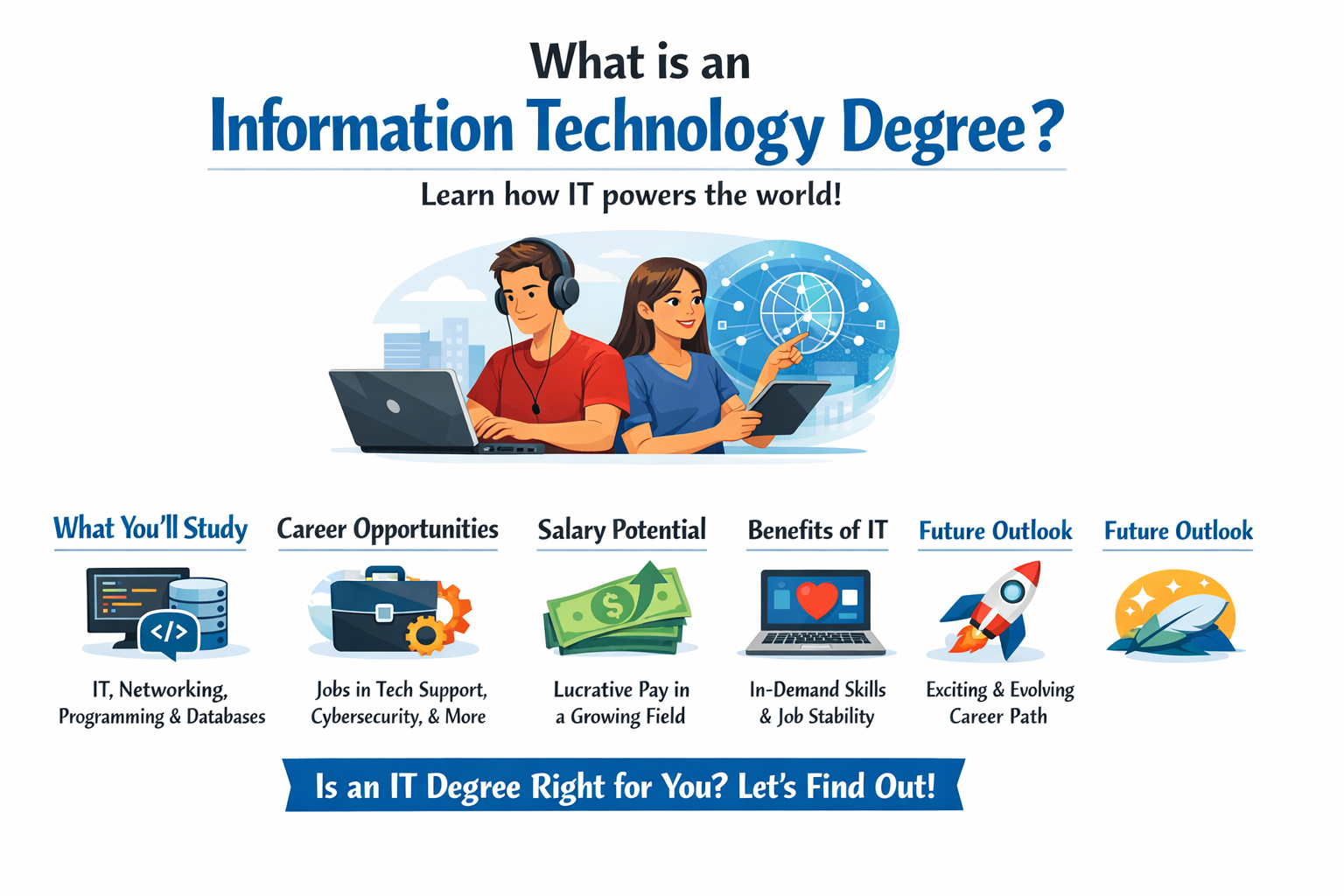
If you’re wondering what is information technology degree, you’re not alone. Thousands of students search for this term every year because IT is one of the fastest-growing career fields in the world. In simple words, an information technology degree is a professional academic program that teaches students how to use computers, networks, software, and databases to solve real-world problems.
Today, businesses depend on technology for almost everything. From online shopping to digital banking, IT professionals make it all possible. That’s why understanding what is information technology degree is essential before choosing your career path.
In this detailed guide, we’ll break down everything you need to know. We’ll explore subjects, career paths, salaries, benefits, and future scope. By the end, you won’t just know what is information technology degree—you’ll know whether it’s right for you.
The Core Meaning of What Is Information Technology Degree
So, what is information technology degree in a deeper sense?
An information technology degree focuses on the practical application of technology in business and organizations. Unlike theoretical computing programs, IT degrees emphasize real-world problem-solving, system management, and technical support.
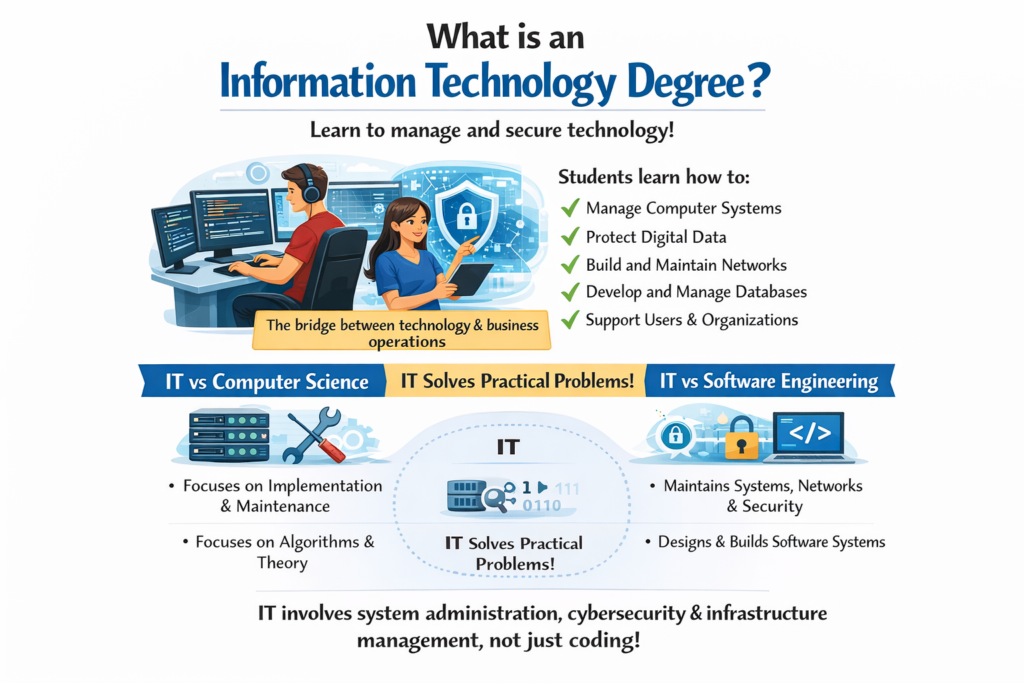
Students learn how to:
- Manage computer systems
- Protect digital data
- Build and maintain networks
- Develop and manage databases
- Support users and organizations
In short, what is information technology degree? It’s a bridge between technology and business operations.
IT vs Computer Science
Many students confuse IT with Computer Science. While both deal with computers, they’re not identical.
- Computer Science focuses on algorithms and theory.
- IT focuses on implementation and maintenance.
If you enjoy solving practical problems and working with systems, then understanding what is information technology degree will help you see why IT might be better for you.
IT vs Software Engineering
Software Engineering is about designing and building software systems. IT, however, deals with maintaining systems, networks, and security.
So when people ask, what is information technology degree, the answer often includes system administration, cybersecurity, and infrastructure management rather than pure coding.
Subjects Covered in an Information Technology Degree
To fully understand what is information technology degree, you need to explore the subjects included in the program.
Programming Fundamentals
Most IT degrees teach programming basics such as:
- Python
- Java
- C++
- Web technologies
Even though IT isn’t purely coding-based, programming skills are essential.
Networking and Cybersecurity
Networking is the backbone of IT. Students learn:
- Network configuration
- Router and switch management
- Cybersecurity principles
- Ethical hacking basics
Database Management
Data is gold in today’s world. IT students learn:
- SQL
- Database design
- Data security
- Data analytics basics
Cloud and Emerging Technologies
Modern IT programs include:
- Cloud computing
- Artificial Intelligence basics
- Internet of Things
- DevOps tools
When exploring what is information technology degree, you’ll notice that it constantly evolves with technology trends.
Types of Information Technology Degrees
Another key aspect of what is information technology degree is understanding its different types.
Associate Degree (2 Years)
- Basic IT skills
- Entry-level job preparation
- Lower cost
Bachelor’s Degree (4 Years)
- Advanced IT concepts
- Internship opportunities
- Better salary potential
Master’s Degree
- Specialization in cybersecurity or data science
- Leadership roles
- Higher salary growth
Online IT Degree Programs
Online learning has become popular. Accredited universities now offer flexible IT programs. According to the U.S. Bureau of Labor Statistics (https://www.bls.gov), IT jobs are projected to grow faster than average, making online IT degrees a smart choice.
15 Powerful Benefits of an Information Technology Degree
Understanding what is information technology degree becomes clearer when you look at its benefits.
- High job demand
- Strong salary potential
- Global career opportunities
- Flexible work options
- Remote work availability
- Continuous learning
- Diverse career paths
- Job security
- Entrepreneurial opportunities
- Industry certifications
- Professional networking
- Problem-solving skills
- Innovation exposure
- Career advancement
- Global recognition
Clearly, when people ask what is information technology degree, they often mean: Is it worth it? The answer is yes—if you enjoy technology.
Career Opportunities After IT Degree
Let’s talk careers. After understanding what is information technology degree, your next question will be: What jobs can I get?
Entry-Level Roles
- IT Support Specialist
- Network Technician
- Junior System Administrator
- Help Desk Analyst
Advanced Roles
- Cybersecurity Analyst
- Cloud Engineer
- IT Manager
- Data Analyst
Because IT touches every industry, graduates can work in healthcare, banking, education, e-commerce, and government sectors.
Salary Expectations and Job Outlook
If you’re researching what is information technology degree, salary is likely on your mind.
IT professionals often earn competitive salaries. Entry-level roles start at moderate pay, but experienced professionals can earn significantly higher salaries.
Job outlook remains strong. Technology continues expanding globally, and organizations need skilled IT experts to manage digital transformation.
Skills Required to Succeed in IT
Knowing what is information technology degree is one thing. Succeeding in it is another.
You’ll need:
- Problem-solving skills
- Communication skills
- Logical thinking
- Technical curiosity
- Teamwork abilities
Soft skills matter just as much as technical knowledge.
How to Choose the Right IT College
Choosing the right institution is crucial when pursuing what is information technology degree.
Consider:
- Accreditation
- Curriculum quality
- Internship opportunities
- Faculty experience
- Placement record
A good college increases job opportunities significantly.
Information Technology Degree vs Certifications
Certifications like:
- CompTIA
- Cisco
- Microsoft
can boost your career. However, they complement but don’t replace a degree.
When asking what is information technology degree, remember it provides structured learning, while certifications offer specialization.
Challenges in IT Education
No degree is perfect. IT has challenges:
- Rapid technology changes
- Continuous learning requirements
- Competitive job market
- Technical complexity
Still, the benefits outweigh the challenges for motivated students.
Future Scope of Information Technology Degree
The future looks bright. Artificial Intelligence, cloud computing, cybersecurity, and data science are growing rapidly.
Understanding what is information technology degree today prepares you for tomorrow’s tech-driven world.
As businesses continue digitizing, IT professionals will remain essential. That’s the long and short of it—technology isn’t going anywhere.
FAQs About What Is Information Technology Degree
1. What is information technology degree in simple words?
It’s a college program that teaches students how to manage computers, networks, and digital systems.
2. Is IT degree good for the future?
Yes. Technology is expanding, and IT jobs are in high demand globally.
3. How many years does an IT degree take?
It usually takes 2 years (Associate) or 4 years (Bachelor’s).
4. Is coding required in IT?
Basic programming is required, but IT focuses more on system management than deep coding.
5. What jobs can I get after IT degree?
You can work as IT support, network engineer, cybersecurity analyst, or cloud engineer.
6. What is information technology degree salary range?
Salaries vary by country and experience, but IT professionals generally earn competitive pay with growth potential.
Conclusion
So, what is information technology degree?
It’s a powerful academic pathway that prepares students to manage, secure, and optimize technology systems in organizations. From networking to cybersecurity, from cloud computing to database management, IT degrees open doors to diverse and rewarding careers.
If you enjoy technology, problem-solving, and innovation, then pursuing an information technology degree could be one of the smartest decisions you’ll ever make.
Technology continues to shape our world. And those who understand what is information technology degree today will lead the digital transformation of tomorrow.