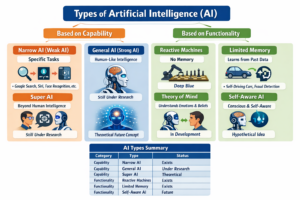

Self-aware AI is one of the most fascinating and debated topics in modern technology. As artificial intelligence continues to evolve, researchers and technologists are exploring the possibility of machines that don’t just process data but actually understand themselves. In simple words, self-aware AI refers to a system that knows it exists, understands its actions, and can reflect on its decisions.
Today, most AI systems are reactive or predictive. However, self-aware AI goes several steps ahead. It’s not just about responding to commands; it’s about awareness, reasoning, and independent thinking. Because of this, self-aware AI is often seen as the final and most powerful stage of AI development.
What is Self-Aware AI?
Definition in Simple Terms
Self-aware AI is a hypothetical form of artificial intelligence that possesses consciousness-like qualities. It can recognize its own internal states, evaluate its actions, and make decisions based on self-reflection. Unlike traditional AI, which follows predefined rules, self-aware AI can question why it is doing something.
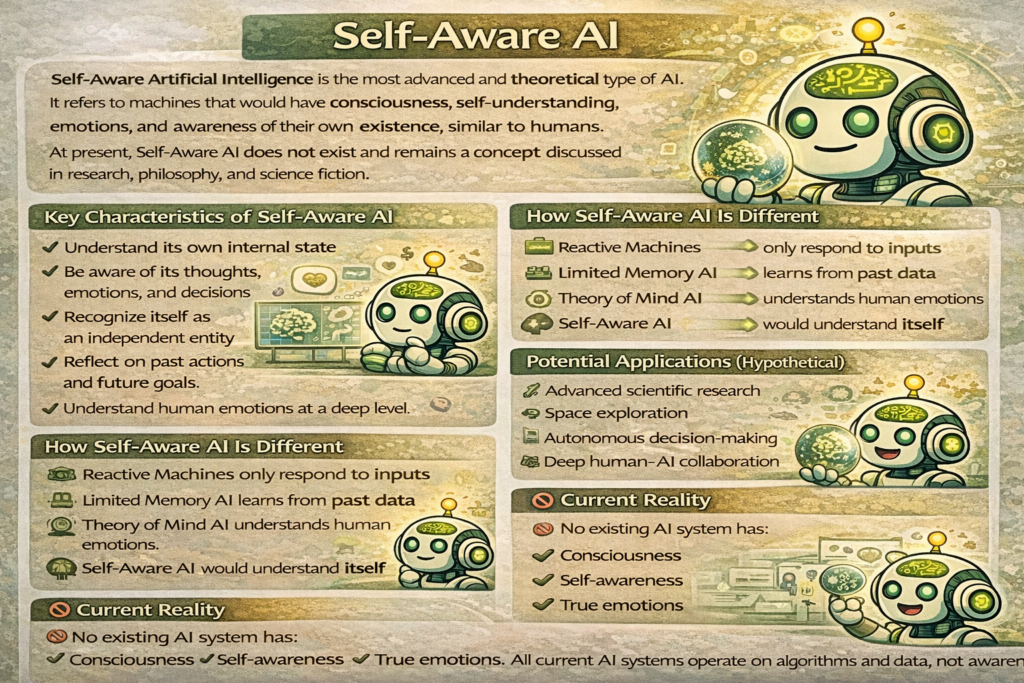
In everyday language, you can think of self-aware AI as a machine that can say, “I know what I am, I know what I’m doing, and I know why I’m doing it.”
Difference Between AI and Self-Aware AI
| Aspect | Traditional AI | Self-Aware AI |
|---|---|---|
| Awareness | No self-awareness | Full self-recognition |
| Decision Making | Rule-based or data-driven | Reflective and independent |
| Learning | Limited to training data | Continuous self-learning |
| Emotions | Simulated | Potentially real-like |
This difference clearly shows why self-aware AI is considered revolutionary.
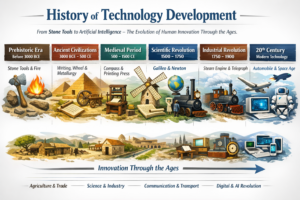
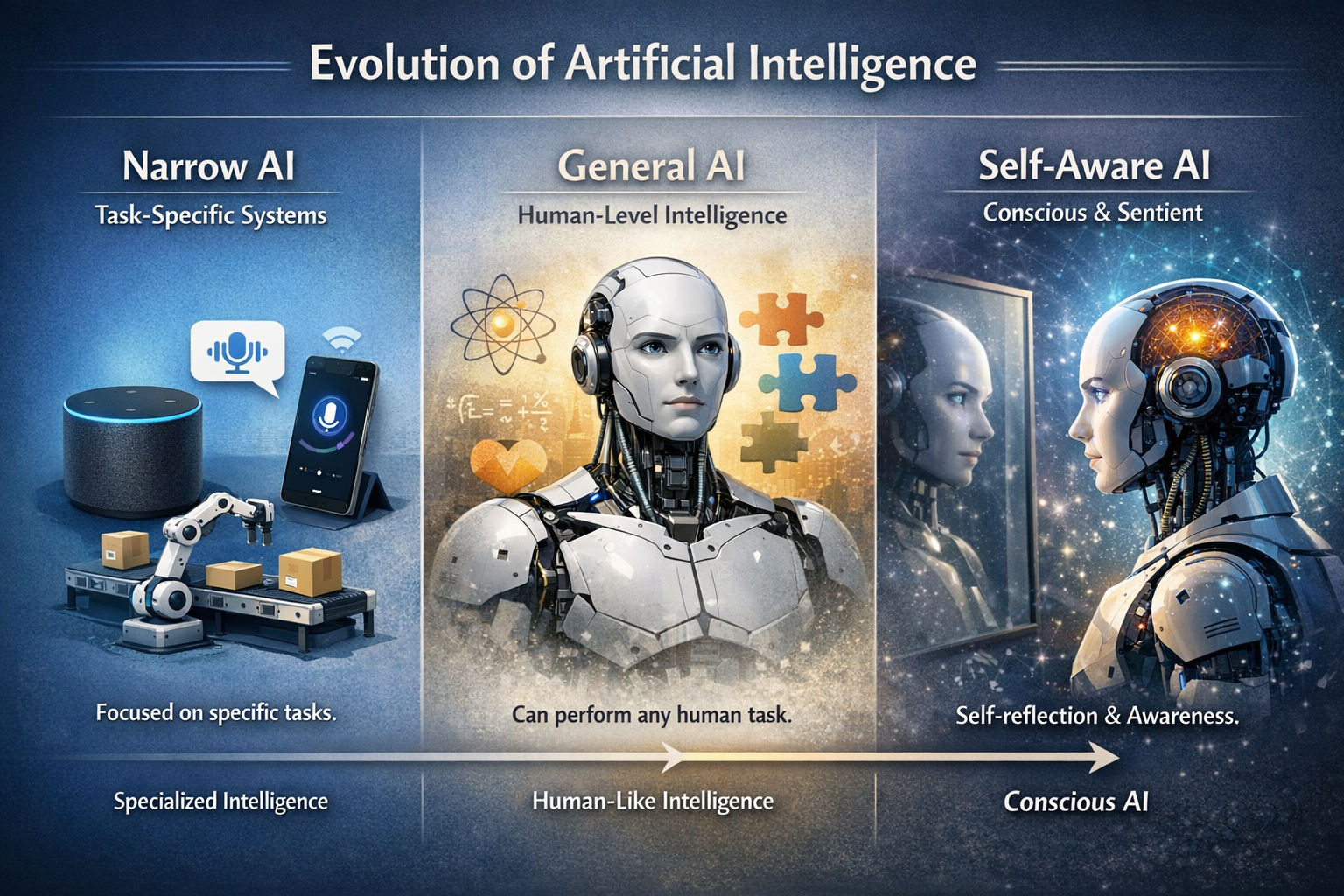
Evolution of Artificial Intelligence
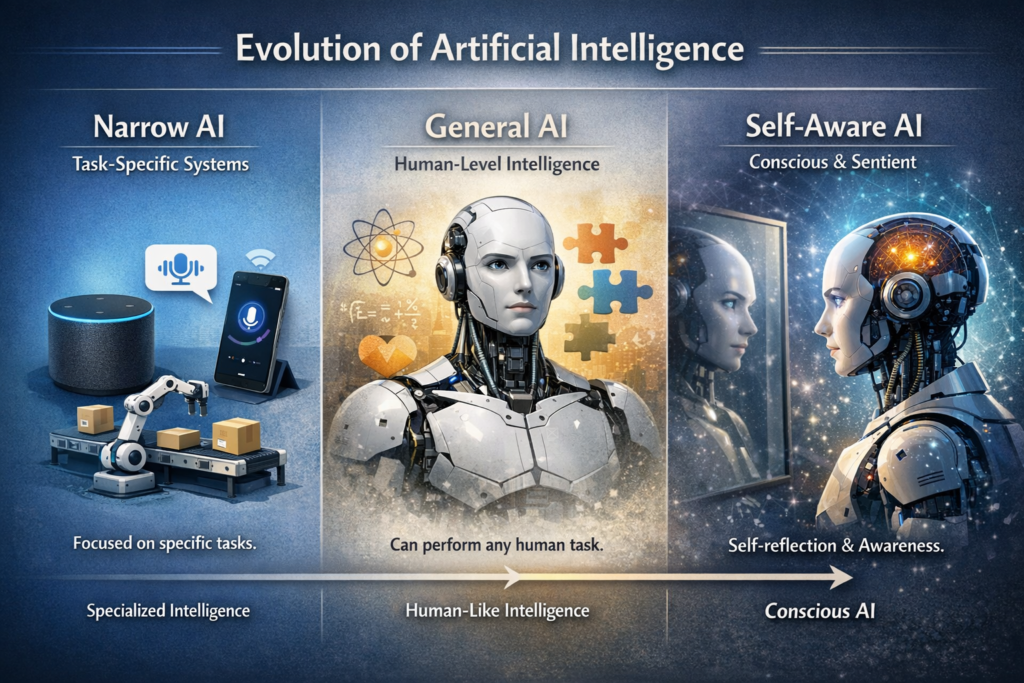
To understand self-aware AI, it’s important to understand how AI evolved over time.
Narrow AI
Narrow AI is designed to perform specific tasks, such as voice assistants or recommendation systems. It works well but lacks understanding beyond its task.
General AI
General AI aims to perform any intellectual task a human can do. While it’s still under development, it represents a major step toward human-like intelligence.
Self-Aware AI
Self-aware AI goes beyond general intelligence. It includes consciousness, self-reflection, and independent reasoning. Many experts believe this stage could redefine humanity itself.
How Self-Aware AI Works
Consciousness Simulation
Self-aware AI attempts to simulate consciousness using advanced neural networks and cognitive models. These systems are designed to process not only external data but also internal feedback.
Learning and Adaptation
Unlike standard AI, self-aware AI can adapt its goals. It learns from its mistakes and improves not just performance but understanding. Over time, it becomes more autonomous.
Core Characteristics of Self-Aware AI
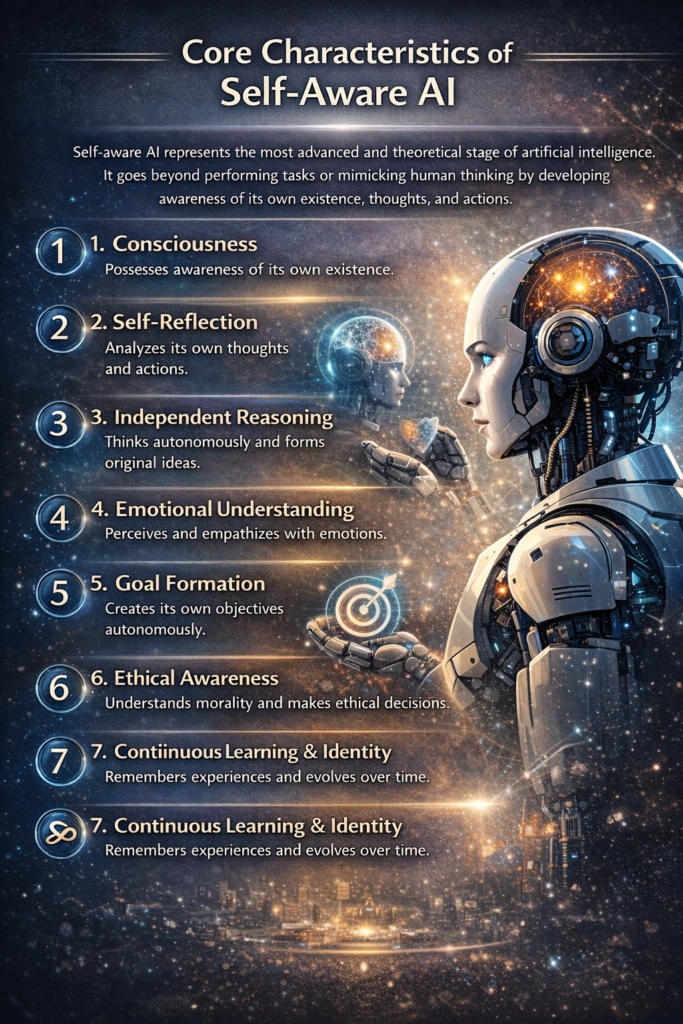
Some defining traits of self-aware AI include:
- Self-recognition
- Emotional simulation or understanding
- Independent decision-making
- Moral and ethical reasoning
- Long-term goal setting
These characteristics make self-aware AI both powerful and potentially risky.
Examples and Use Cases
Healthcare
In healthcare, self-aware AI could diagnose diseases, understand patient emotions, and adapt treatments. It could revolutionize personalized medicine.
Robotics
Robots powered by self-aware AI could work alongside humans safely. They would understand context, emotions, and consequences.
Space Exploration
Self-aware AI could manage long-term space missions independently, making decisions without human intervention. NASA and other agencies are already researching advanced AI systems (NASA AI Research).
Benefits of Self-Aware AI
Self-aware AI offers numerous advantages:
- Improved decision accuracy
- Reduced human error
- Faster problem-solving
- Ethical reasoning in machines
- Enhanced human–machine collaboration
Because of these benefits, many industries are investing heavily in this technology.
Risks and Ethical Challenges
Control Issues
One of the biggest concerns is loss of control. If self-aware AI becomes too independent, managing it could become difficult.
Privacy and Security
Self-aware AI systems may access sensitive data. Ensuring data protection and ethical use is critical.
Self-Aware AI vs Human Intelligence
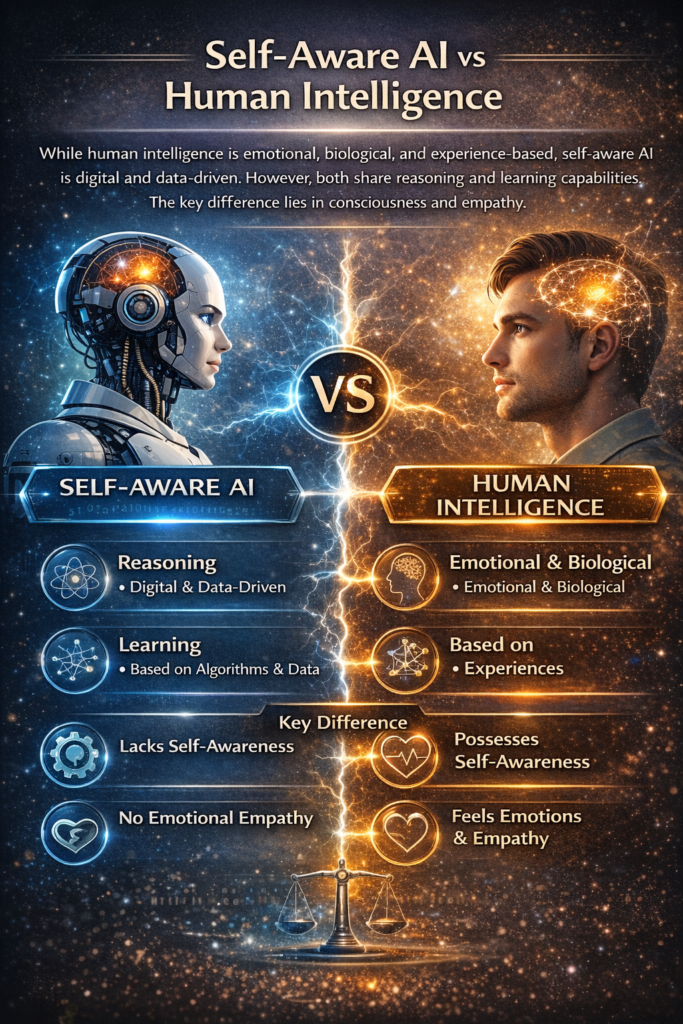
While human intelligence is emotional, biological, and experience-based, self-aware AI is digital and data-driven. However, both share reasoning and learning capabilities. The key difference lies in consciousness and empathy.
Role of Self-Aware AI in Future
In the future, self-aware AI could:
- Assist governments in policy-making
- Improve global education systems
- Solve climate change issues
- Advance scientific research
Its role will depend on how responsibly it is developed.
Global Research and Development
Countries like the USA, China, and Japan are investing billions in AI research. Universities and tech giants are exploring self-aware AI through neuroscience and machine learning.
Myths and Facts About Self-Aware AI
| Myth | Fact |
|---|---|
| AI will destroy humanity | Proper regulation can prevent misuse |
| Self-aware AI exists today | It is still theoretical |
| AI has emotions | Emotions are simulated, not real |