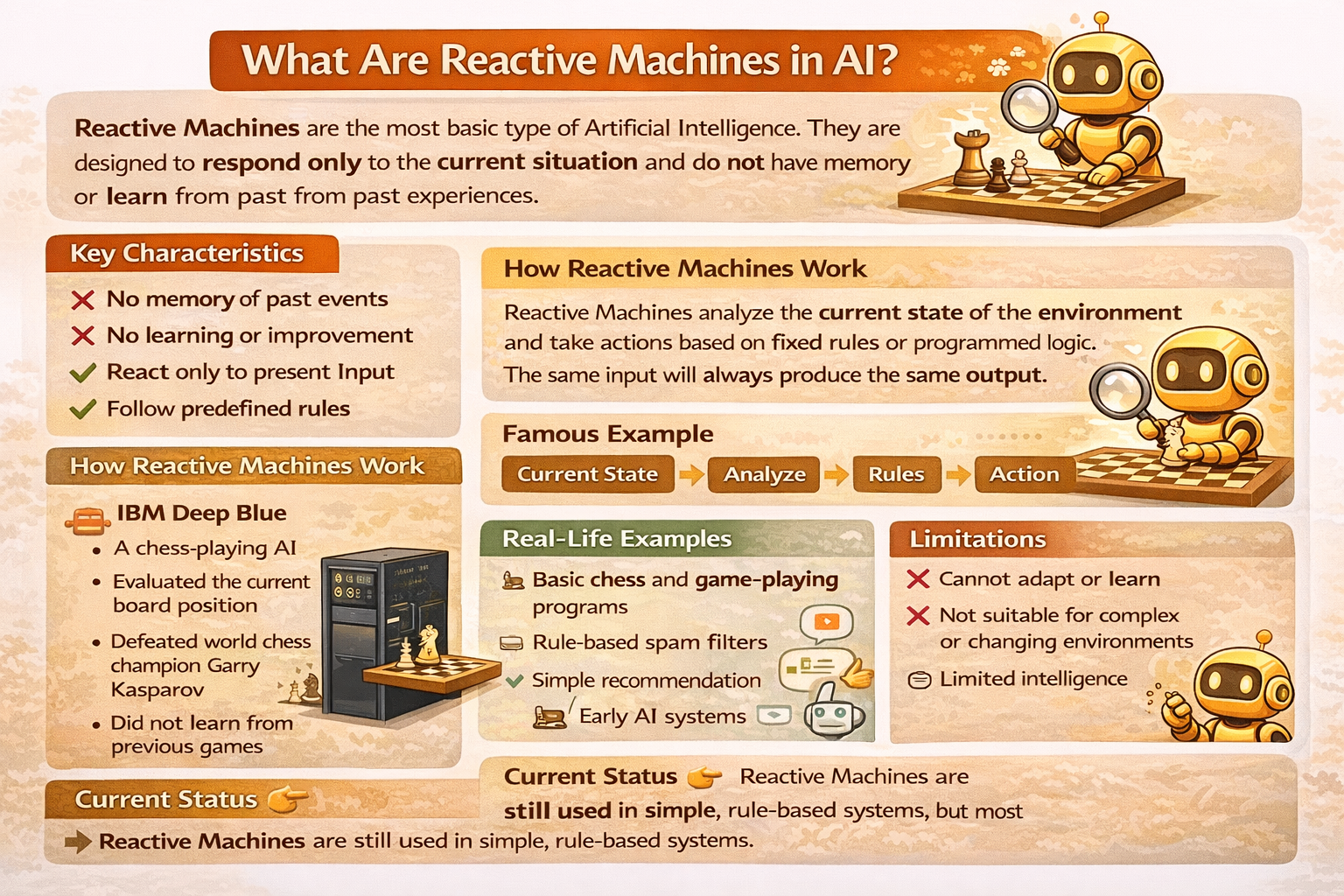
Reactive machines in AI are the simplest and most foundational form of artificial intelligence. They don’t store memories, learn from past experiences, or improve over time. Instead, they respond to current inputs with predefined outputs. Sounds basic, right? Yet, despite their simplicity, reactive machines in AI still play a vital role in modern technology.
In the first 10% of this article, it’s important to clarify that reactive machines in AI laid the groundwork for all advanced AI systems we see today. Without them, complex models like machine learning and deep learning wouldn’t exist. Think of them as the sturdy roots of a very tall technological tree.
Understanding Artificial Intelligence Classifications
Artificial intelligence is commonly divided into categories based on capability and functionality. These classifications help researchers and developers choose the right AI approach for specific problems.
Where Reactive Machines Fit in AI Types
Reactive machines in AI belong to the functional type classification. According to AI theory, there are four main types:
- Reactive Machines
- Limited Memory
- Theory of Mind
- Self-Aware AI
Reactive machines sit at the base level. They don’t use historical data, emotions, or self-awareness. They simply react—quickly and consistently.
What Are Reactive Machines in AI?
Core Definition and Meaning
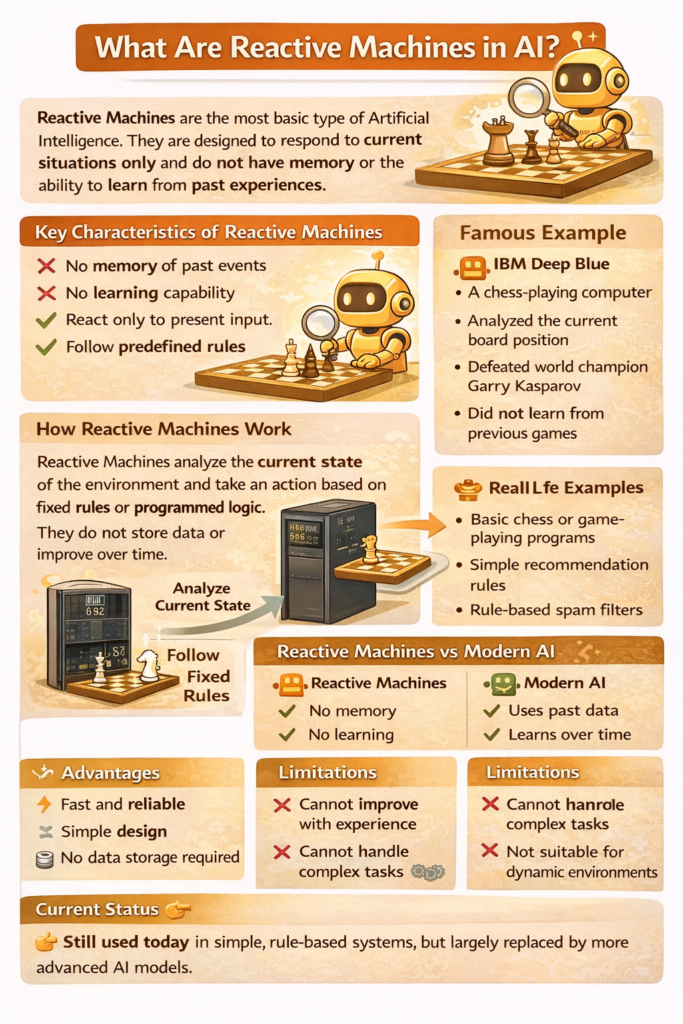
Reactive machines in AI are systems that perceive the present state and act accordingly without referencing the past. There’s no internal memory, no learning loop, and no adaptation over time.
A helpful definition from academic AI literature describes them as “stateless systems that map inputs directly to outputs based on predefined rules.”
Key Characteristics of Reactive Machines
Reactive machines in AI typically share these traits:
- No memory or data storage
- No learning capability
- Predictable behavior
- High reliability in controlled environments
- Fast response time
Because they don’t “think back,” they’re less prone to unexpected behavior. That’s a big plus in safety-critical systems.
How Reactive Machines in AI Work
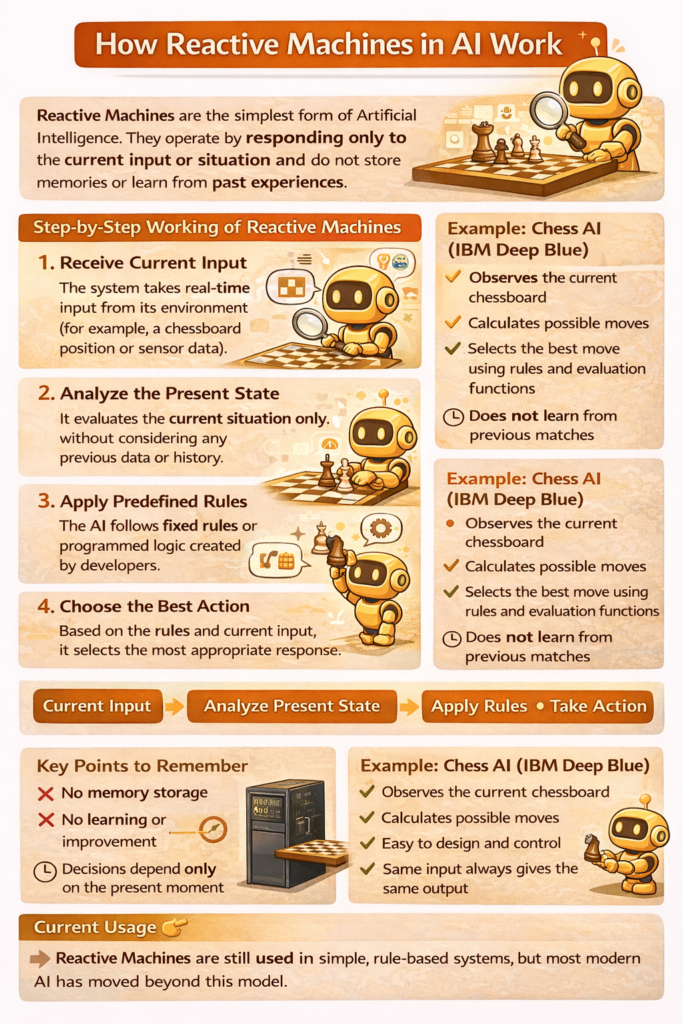
Input–Output Mechanism
At their core, reactive machines in AI function on a simple principle: if X happens, do Y. The system observes the environment, processes the input through fixed rules, and produces an output.
For example, in a chess-playing reactive AI, the system evaluates the current board and chooses the best move from a predefined strategy set—no memory of previous games required.
No Memory, No Learning Explained
Unlike machine learning systems, reactive machines in AI don’t improve over time. They don’t store past interactions or outcomes. While that might sound like a drawback, it’s actually a strength in environments where consistency is crucial.
Real-World Examples of Reactive Machines in AI
IBM Deep Blue Chess System
One of the most famous examples of reactive machines in AI is IBM’s Deep Blue, which defeated world chess champion Garry Kasparov in 1997. Deep Blue didn’t learn from past matches. Instead, it evaluated millions of possible moves in real time using brute-force computation.
You can read more about Deep Blue on Wikipedia’s AI history section.
Rule-Based Recommendation Engines
Simple recommendation systems—like “if you bought X, show Y”—often rely on reactive logic. These systems don’t analyze user history deeply; they respond to immediate actions.
Advantages of Reactive Machines in AI
Reactive machines in AI offer several benefits that still make them relevant:
- Simplicity: Easy to design and deploy
- Transparency: Decisions are explainable
- Speed: No memory lookup means faster responses
- Reliability: Consistent behavior under fixed conditions
In industries like manufacturing and safety systems, these advantages are hard to ignore.
Limitations of Reactive Machines in AI
Of course, reactive machines in AI aren’t perfect. Their limitations include:
- Inability to learn or adapt
- Poor performance in dynamic environments
- Limited scalability for complex tasks
Because they can’t evolve, they’re unsuitable for tasks requiring personalization or long-term planning.
Reactive Machines vs Other AI Types
Reactive Machines vs Limited Memory AI
Limited memory AI can learn from historical data—think self-driving cars analyzing past traffic patterns. Reactive machines in AI, on the other hand, live strictly in the present moment.
Reactive Machines vs Self-Aware AI
Self-aware AI is still theoretical. Unlike reactive machines in AI, self-aware systems would understand emotions, consciousness, and self-identity.
Use Cases and Applications Today
Even today, reactive machines in AI are used in:
- Industrial automation
- Traffic signal systems
- Simple robotics
- Game AI
- Embedded safety systems
They’re especially useful where rules rarely change.
Future Relevance of Reactive Machines in AI
You might wonder—do reactive machines in AI have a future? Absolutely. While advanced AI gets the spotlight, reactive systems remain essential for reliability, safety, and cost efficiency.
In hybrid AI models, reactive components often handle real-time decisions while advanced models manage learning and planning.
Ethical and Practical Considerations
From an ethical standpoint, reactive machines in AI are easier to regulate. Their predictability reduces the risk of biased or harmful behavior. Practically speaking, they’re also cheaper and easier to audit.