Quantum computing basics are becoming one of the most talked-about topics in modern technology. As we move deeper into the digital age, traditional computers are reaching their limits. That’s where quantum computing steps in—and honestly, it’s nothing short of revolutionary.
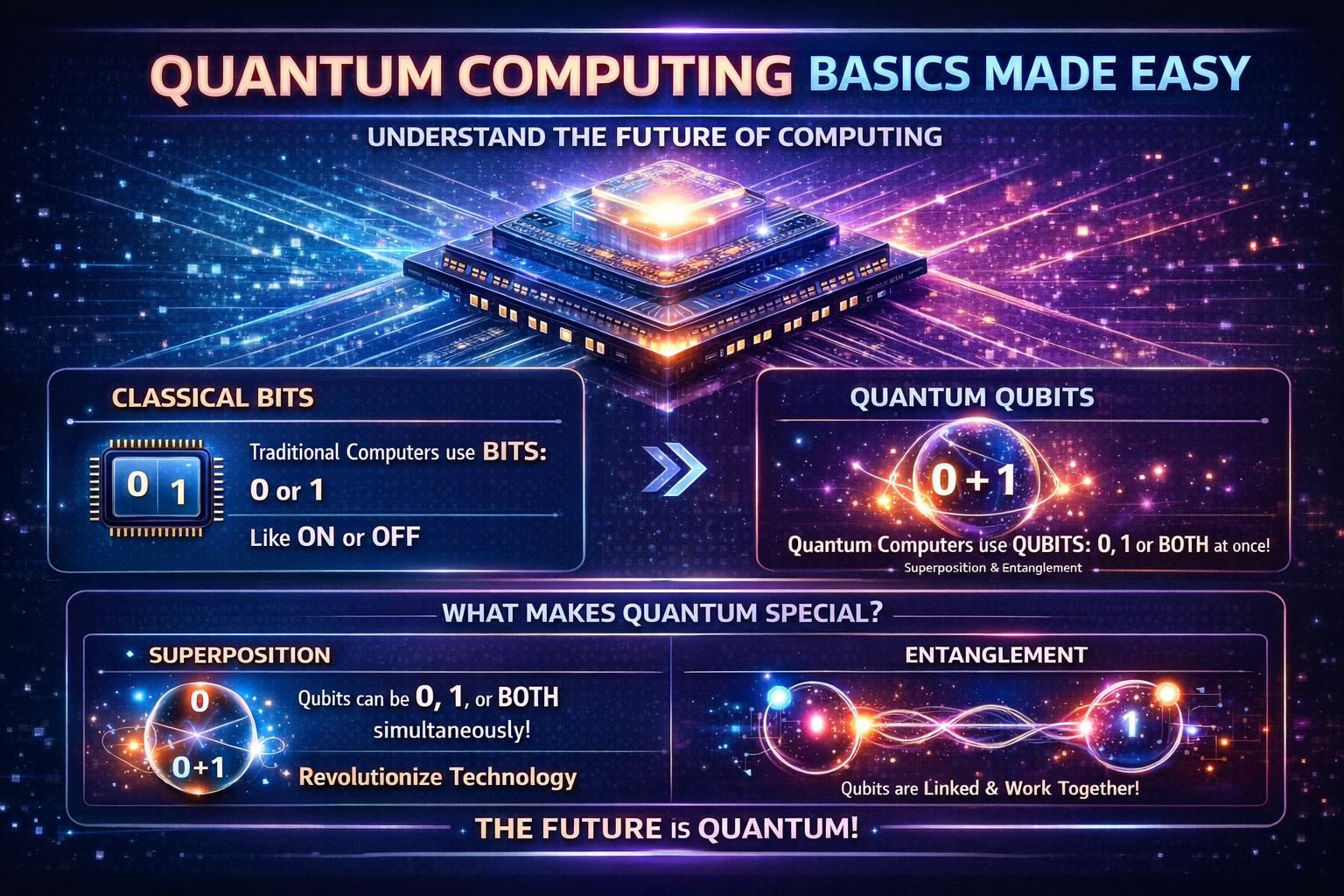
Unlike classical computers that process data in bits (0s and 1s), quantum computers use quantum bits or qubits. These qubits unlock a whole new level of computing power. So, if you’ve ever wondered how future technology might solve complex problems in seconds, you’re in the right place.
In this guide, we’ll break down quantum computing basics in a simple, easy-to-understand way. No complicated jargon—just clear explanations that anyone can follow.
What is Quantum Computing?
Quantum computing is a type of computing that uses the principles of quantum mechanics to process information. Instead of relying on traditional binary systems, it uses quantum states.
Classical vs Quantum Computing

In simple terms, classical computers are like single-lane roads, while quantum computers are multi-lane highways.
Key Principles of Quantum Computing
Understanding quantum computing basics requires learning a few core principles.
Superposition
Superposition allows qubits to exist in multiple states at the same time. Think of it like flipping a coin—it’s both heads and tails until it lands.
Entanglement
Entanglement connects qubits in such a way that the state of one instantly affects the other—even if they are miles apart.
Quantum Interference
This principle helps quantum systems amplify correct answers and cancel out wrong ones.
Together, these principles make quantum computing incredibly powerful.
Qubits Explained
Qubits are the heart of quantum computing basics.
Binary Bits vs Qubits
- Bits: Either 0 or 1
- Qubits: 0, 1, or both simultaneously
This ability allows quantum computers to perform multiple calculations at once.
Quantum Gates and Circuits
Quantum gates are like logic gates in classical computing but far more advanced. They manipulate qubits to perform operations.
Some common quantum gates include:
- Hadamard Gate
- Pauli-X Gate
- CNOT Gate
These gates form quantum circuits, which execute algorithms.
Types of Quantum Computers
There are different types of quantum computers, including:
- Superconducting Quantum Computers
- Trapped Ion Quantum Computers
- Topological Quantum Computers
- Photonic Quantum Computers
Each type uses different technologies but follows the same quantum computing basics.
Real-World Applications
Quantum computing isn’t just theoretical—it’s already making waves.
Healthcare
Quantum computing can:
- Speed up drug discovery
- Simulate molecules
- Improve diagnostics
Finance
Banks use quantum computing for:
- Risk analysis
- Fraud detection
- Portfolio optimization
Cybersecurity
Quantum computers can both:
- Break traditional encryption
- Create ultra-secure encryption systems
Advantages of Quantum Computing
Here’s why quantum computing basics matter:
- ⚡ Faster problem-solving
- 🔍 Better optimization
- 🔐 Advanced security
- 🧠 Complex simulations
It’s like upgrading from a bicycle to a rocket.
Challenges and Limitations
Despite its power, quantum computing faces challenges:
- High cost
- Error rates
- Limited scalability
- Requires extreme conditions
So yes, it’s powerful—but not perfect (yet).
Future of Quantum Computing
The future looks bright. Experts believe quantum computing will:
- Transform industries
- Solve global problems
- Revolutionize AI
Big tech companies are investing heavily in this field, which means rapid progress is coming.
How to Learn Quantum Computing Basics
If you’re interested in learning quantum computing basics, here’s how to start:
Step-by-Step Guide
- Learn basic physics
- Understand linear algebra
- Explore quantum mechanics
- Take online courses
👉 Recommended resource:
https://quantum.country (Great beginner-friendly guide)
FAQs on Quantum Computing Basics
1. What are quantum computing basics?
Quantum computing basics include concepts like qubits, superposition, and entanglement.
2. Is quantum computing difficult to learn?
Not really. With the right resources, anyone can understand the basics.
3. Are quantum computers available today?
Yes, but they are still in early development stages.
4. What is a qubit?
A qubit is the basic unit of quantum information.
5. Why is quantum computing important?
It can solve complex problems much faster than classical computers.
6. Can quantum computers replace classical computers?
No, they will likely work together for different tasks.
Conclusion
Quantum computing basics are no longer just a topic for scientists—they’re becoming essential knowledge for the future. From healthcare to cybersecurity, quantum technology is set to transform the world in ways we can barely imagine today.
Sure, there are challenges. But the potential? Absolutely massive.
If you start learning quantum computing basics now, you’ll be ahead of the curve—and ready for the next big tech revolution.