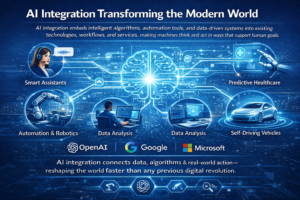
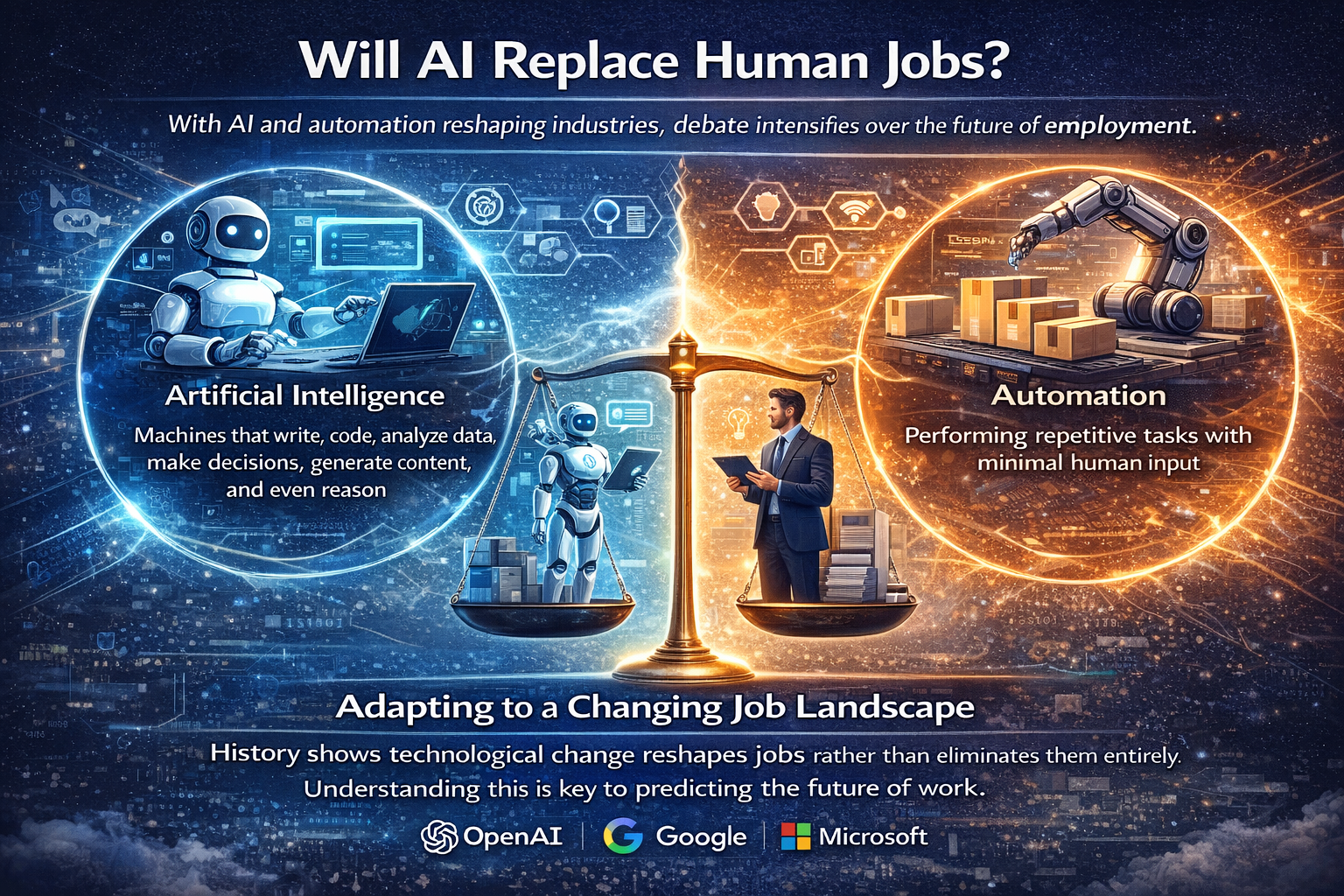
The debate around whether AI replace human jobs in future scenarios will truly unfold has intensified as intelligent systems become more capable each year. Artificial intelligence refers to computer systems designed to perform tasks that usually require human intelligence, such as recognising speech, analysing data, making decisions, and generating content. Automation, meanwhile, focuses on performing repetitive processes with minimal human input.
Modern AI systems—like those developed by organisations such as OpenAI, Google, and Microsoft—have accelerated this transformation. Tools including ChatGPT demonstrate how machines can now write, code, summarise, and even reason in ways once thought uniquely human.
Yet history shows that technological change rarely eliminates work entirely. Instead, it reshapes the nature of jobs. Understanding this distinction is essential before drawing conclusions about the future of employment.
Many experts now believe that AI replace human jobs in future scenarios will reshape how societies define employment and productivity.
Why Businesses Are Rapidly Adopting AI
Companies across industries are investing heavily in AI because the economic incentives are powerful. Intelligent automation reduces operational costs, increases speed, and improves accuracy. For example, AI can analyse millions of financial transactions in seconds, something impossible for a human workforce alone.
Additionally, AI enables 24/7 service, predictive decision-making, and personalised customer experiences. Businesses that ignore these capabilities risk falling behind competitors who embrace them. Consequently, adoption is not merely optional—it’s becoming a survival strategy.
However, while efficiency rises, concerns about job displacement grow. This tension sits at the heart of the question: will AI ultimately replace more jobs than it creates?
This growing dependence strengthens the belief that AI replace human jobs in future across multiple sectors.
Historical Examples of Technology Replacing Jobs
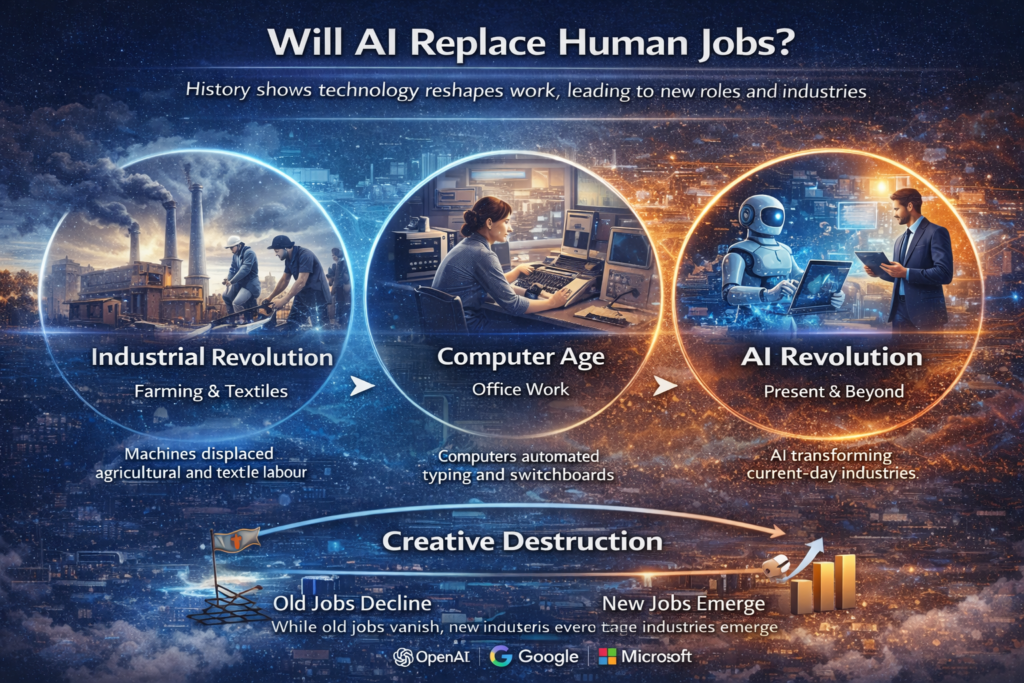
To understand whether AI replace human jobs in future economies, it helps to examine past technological revolutions. During the Industrial Revolution, machines replaced many manual labour roles in agriculture and textiles. Later, computers reduced the need for typists and switchboard operators.
Despite these disruptions, overall employment eventually increased because new industries emerged. Technology changed what people did rather than eliminating work entirely. Economists often call this the “creative destruction” cycle—old roles disappear, but new ones arise.
AI appears to follow a similar trajectory, though the speed of change today is much faster than in previous centuries.
Jobs Most at Risk from AI
Routine Office Work
Administrative, data entry, and scheduling roles are among the most vulnerable. AI systems can already organise calendars, process documents, and generate reports automatically. As accuracy improves, demand for purely repetitive office tasks may decline sharply.
Manufacturing and Logistics
Robotics combined with AI vision systems allow factories and warehouses to operate with fewer human workers. Autonomous vehicles may further transform delivery and transport industries in the coming decades.
Customer Support
These examples clearly illustrate how AI replace human jobs in future is no longer theoretical but already visible in daily operations.
AI chatbots and voice assistants now resolve many common customer queries instantly. Human agents increasingly handle only complex or emotional cases, reducing the total number of support staff required.
Jobs AI Is Creating Instead
While some roles shrink, entirely new professions are emerging. AI engineers, data scientists, prompt designers, and automation consultants are already in high demand. Creative industries are also evolving, with professionals using AI as a collaborative tool rather than a replacement.
Importantly, many future jobs don’t yet exist. Just as social media managers were unimaginable before the internet era, AI will generate roles we cannot fully predict today.
Human Skills That Machines Cannot Replace
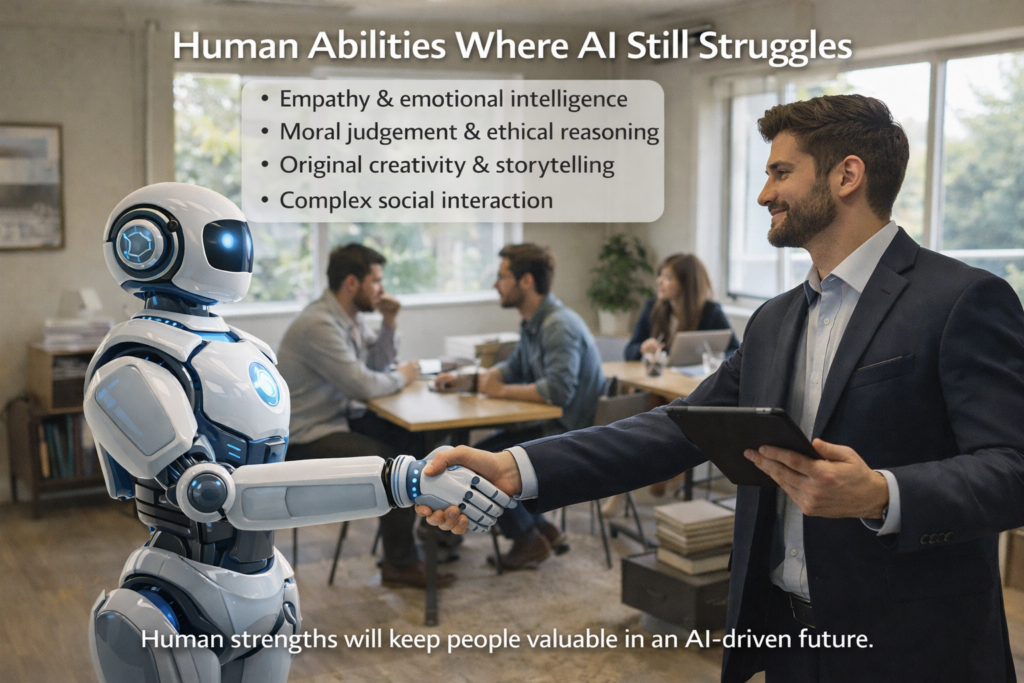
Even the most advanced AI struggles with certain deeply human abilities:
- Empathy and emotional intelligence
- Moral judgement and ethical reasoning
- Original creativity and storytelling
- Complex social interaction
These strengths suggest the future of work will centre on human-AI collaboration rather than total replacement. Workers who cultivate interpersonal and creative skills are likely to remain valuable.
Economic Impact of AI on the Global Workforce
AI promises enormous productivity gains, potentially increasing global GDP by trillions of pounds. However, benefits may not be distributed equally. High-skill workers and technology owners could gain the most, while routine workers face disruption.
If unmanaged, the pace at which AI replace human jobs in future could widen income gaps between high-skill and routine workers.
Governments therefore play a crucial role in managing transition through taxation policy, social safety nets, and education reform. Without thoughtful planning, inequality could widen even as economies grow.
Education and Reskilling for the AI Era
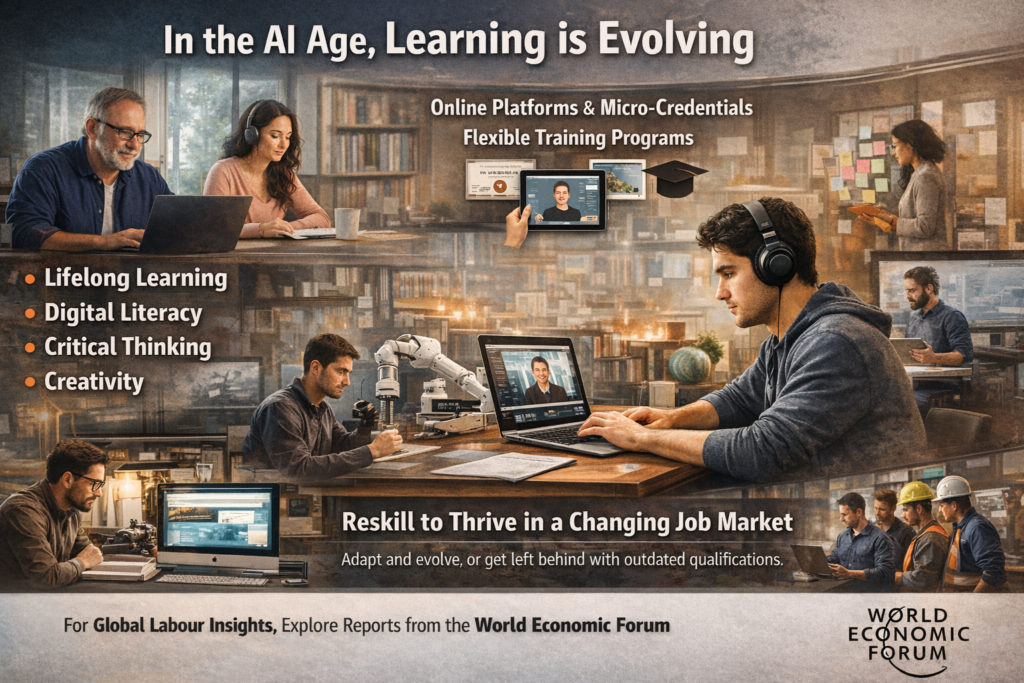
Traditional education models focused on memorisation are becoming outdated. The AI age demands:
- Lifelong learning
- Digital literacy
- Critical thinking
- Creativity
Online platforms, micro-credentials, and flexible training programmes are expanding rapidly to meet this need. Workers who continuously reskill will adapt far more successfully than those who rely on static qualifications.
For deeper global labour insights, readers can explore reports from the World Economic Forum at
https://www.weforum.org/
Ethical Concerns and Governance
As AI systems influence hiring, finance, healthcare, and law enforcement, ethical risks become significant. Bias in algorithms, privacy violations, and lack of transparency are major concerns.
Responsible governance requires:
- Clear regulation
- Transparent AI models
- Human oversight
- Accountability for harm
Balancing innovation with protection will define trustworthy AI adoption worldwide.
Future Predictions for 2030–2040
Experts broadly agree on several trends:
- Partial automation of most jobs, not full replacement.
- Expansion of creative and analytical roles.
- Shorter workweeks due to productivity gains.
- Greater demand for human-centred professions such as healthcare and education.
Thus, the phrase AI replace human jobs in future may prove oversimplified. Transformation—not extinction—appears more realistic.
How Individuals Can Stay Secure
Workers can prepare today by:
- Learning digital and AI-related skills
- Strengthening communication abilities
- Building adaptable career paths
- Embracing continuous education
Rather than fearing AI, proactive adaptation offers the safest path forward.
FAQs
1. Will AI completely replace human workers?
No. Most experts predict collaboration between humans and AI rather than total replacement.
2. Which industries face the biggest disruption?
Manufacturing, transport, administration, and customer service are among the most affected.
3. Can new jobs truly offset lost ones?
Historically, technology has always created new roles, though transitions can be challenging.
4. What skills are safest in the AI era?
Creativity, empathy, leadership, and critical thinking remain difficult to automate.
5. How soon will major job changes occur?
Significant shifts are already happening and will accelerate through the 2030s.
6. Should people fear AI or embrace it?
Preparation and learning are more useful than fear. AI can enhance productivity and opportunity.
Conclusion
The question of whether AI replace human jobs in future economies cannot be answered with a simple yes or no. AI will undoubtedly transform employment, automating routine tasks while creating new possibilities. The ultimate outcome depends on education, governance, and human adaptability.
Encouragingly, history suggests that while technology changes work, it rarely eliminates humanity’s role within it. By focusing on uniquely human strengths and embracing lifelong learning, society can shape an AI-powered future that is not only efficient—but also inclusive and meaningful.
The real challenge is not whether AI replace human jobs in future, but how humanity prepares for that transformation responsibly.