
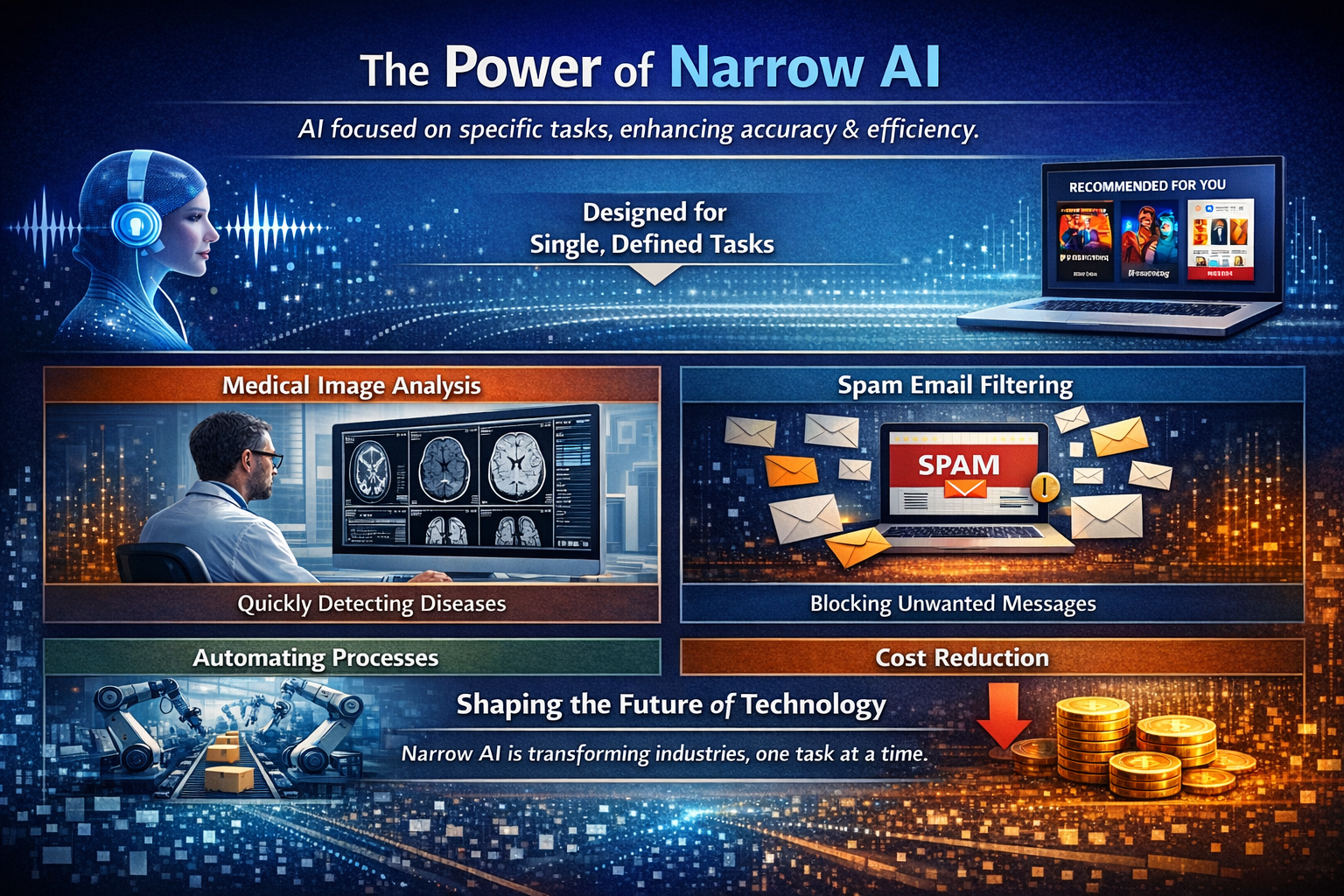
Narrow AI refers to artificial intelligence systems built to perform a single specific task or a limited range of functions. Unlike broader intelligent systems imagined in science fiction, Narrow AI focuses on precision rather than general reasoning. Today, nearly every AI-powered tool people use—from voice assistants to recommendation engines—belongs to this category.
Because Narrow AI is designed for defined objectives, it often performs tasks faster and more accurately than humans. For example, image recognition software can analyse thousands of medical scans in minutes. Similarly, spam filters quickly identify unwanted emails using trained data models.
The growing adoption of Narrow AI across industries shows how practical and impactful this technology has become. Organisations rely on it to automate processes, reduce costs, and improve decision-making. As digital transformation accelerates, Narrow AI continues to shape the modern technological landscape in subtle yet powerful ways.
What Makes Narrow AI Different from General AI
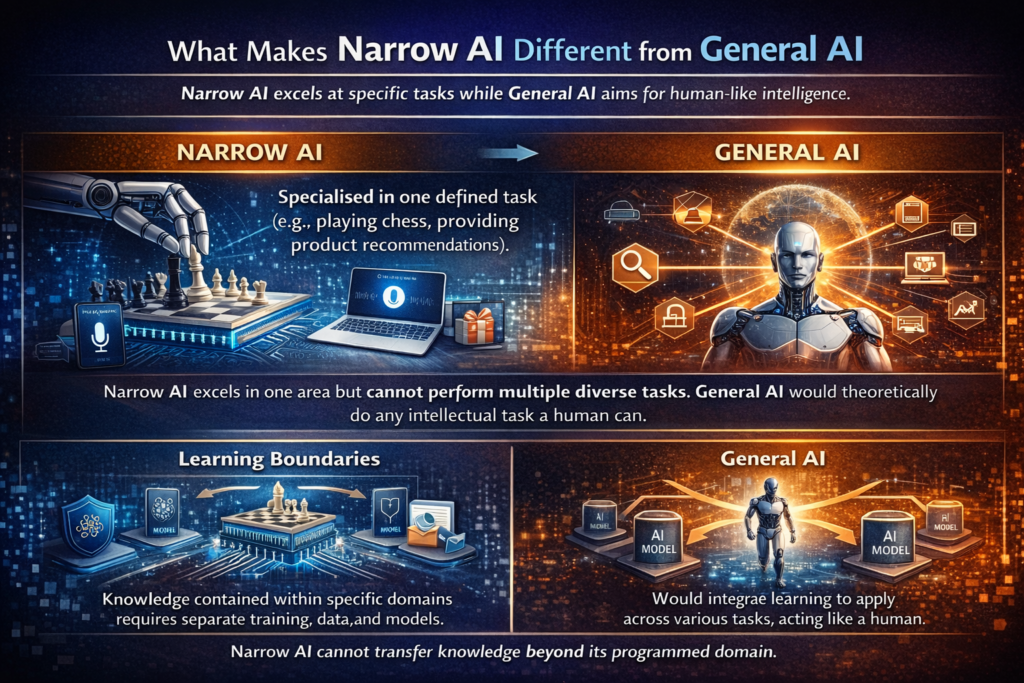
The biggest difference between Narrow AI and broader artificial intelligence concepts lies in scope. Narrow AI handles one defined task, while General AI would theoretically perform any intellectual task a human can do.
Task-Specific Intelligence
Narrow AI systems excel in clearly structured environments. A chess-playing AI, for instance, can defeat world champions but cannot drive a car or hold a conversation about history. This specialisation is both its greatest strength and its main limitation.
Learning Boundaries
Although Narrow AI uses machine learning to improve performance, it cannot transfer knowledge beyond its programmed domain. Each new capability requires separate training, datasets, and models. This boundary prevents it from achieving true human-like intelligence.
History and Evolution of Narrow AI
The roots of Narrow AI trace back to the mid-20th century, when early computer scientists experimented with rule-based programs. Initial systems could solve mathematical problems or play simple games, demonstrating that machines could mimic limited reasoning.
During the 1990s and 2000s, improvements in computing power and data availability accelerated progress. Search engines, speech recognition, and recommendation algorithms emerged as practical examples of Narrow AI in everyday life.
In recent years, deep learning has dramatically expanded Narrow AI capabilities. Systems can now recognise faces, translate languages, generate text, and detect diseases. According to research highlighted by organisations like ****, AI adoption continues to rise globally, driven largely by specialised applications rather than general intelligence.
How Narrow AI Works
this AI operates through algorithms trained on data to recognise patterns and make predictions. Instead of true understanding, it relies on statistical relationships within datasets.
Machine Learning Role
Machine learning enables systems to learn from examples rather than explicit programming. Models adjust internal parameters until predictions match expected outcomes. Over time, performance improves with more training data.
Data Dependency
Data quality directly determines AI accuracy. Biased or incomplete datasets can produce incorrect or unfair results, making ethical data handling essential. Consequently, organisations invest heavily in data governance and validation.
Real-World Applications of Narrow AI
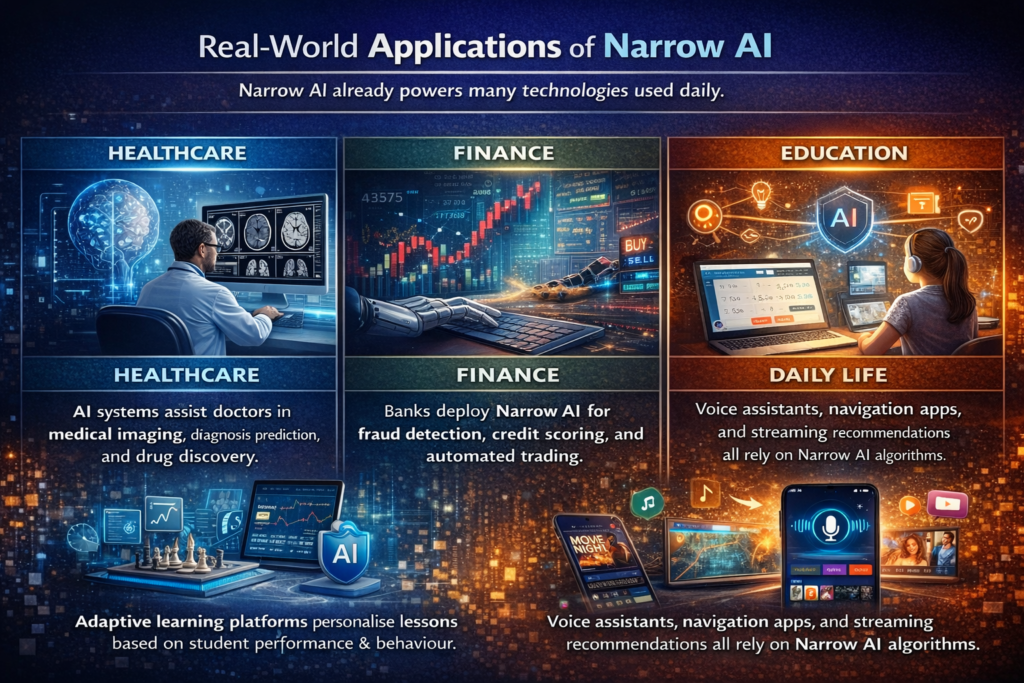
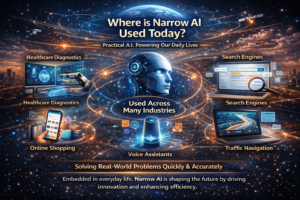
NarrowAI already powers many technologies used daily. Its influence spans healthcare, finance, education, and entertainment.
Healthcare
AI systems assist doctors in medical imaging, diagnosis prediction, and drug discovery. Early disease detection improves survival rates and reduces treatment costs.
Finance
Banks deploy NarrowAI for fraud detection, credit scoring, and automated trading. These tools analyse vast transaction data in real time, improving security and efficiency.
Education
Adaptive learning platforms personalise lessons based on student performance and behaviour, helping learners progress at their own pace.
Daily Life
Voice assistants, navigation apps, and streaming recommendations all rely on Narrow AI algorithms to deliver convenient user experiences.
Advantages of Narrow AI
Narrow AI offers several clear benefits:
- High accuracy in specialised tasks
- Automation of repetitive work
- Cost and time efficiency
- Scalability across industries
- Continuous improvement through data
These strengths explain why businesses increasingly integrate AI into core operations.
Limitations and Risks
Despite its usefulness, Narrow AI has notable challenges:
- Lack of general understanding
- Dependence on large datasets
- Potential bias and ethical concerns
- Job displacement in some sectors
Addressing these risks requires responsible AI governance, transparency, and regulation.
Narrow AI vs General AI vs Super AI
| Feature | Narrow AI | General AI | Super AI |
|---|---|---|---|
| Scope | Single task | Human-level intelligence | Beyond human intelligence |
| Availability | Widely used today | Not yet achieved | Hypothetical |
| Risk Level | Manageable | Significant | Unknown |
| Examples | Voice assistants, recommendations | None real | Sci-fi concept |
This comparison shows that current technology remains firmly within the Narrow AI stage.
Future of Narrow AI
The future of Narrow AI looks extremely promising. Advancements in computing, cloud infrastructure, and data collection will continue improving system performance. Emerging trends include:
- AI-driven healthcare diagnostics
- Autonomous transportation systems
- Smarter virtual assistants
- Enhanced cybersecurity detection
Rather than disappearing, Narrow AI will likely become more integrated and invisible, quietly powering everyday experiences.
Frequently Asked Questions
1. What is Narrow AI in simple terms?
Narrow AI is artificial intelligence designed to perform one specific task very efficiently.
2. Is Narrow AI the same as machine learning?
Machine learning is a method used to build Narrow AI, but the terms are not identical.
3. Can Narrow AI become General AI?
Researchers are working toward this goal, but true General AI does not yet exist.
4. Where is Narrow AI used today?
It appears in healthcare, finance, education, smartphones, and online services.
5. Is Narrow AI dangerous?
By itself, it is generally safe, though bias, misuse, and automation risks must be managed.
6. What is the future of Narrow AI?
It will continue expanding across industries, improving efficiency, accuracy, and innovation.
Conclusion
this AI represents the most practical and widely used form of artificial intelligence today. While it lacks human-level reasoning, its ability to perform specialised tasks with remarkable speed and precision makes it invaluable. From healthcare diagnostics to personalised recommendations, Narrow AI already shapes modern life in meaningful ways.
Looking ahead, continued innovation will deepen its influence across industries. At the same time, ethical governance and responsible design will remain essential to ensure technology benefits society as a whole. Ultimately, Narrow AI is not just a stepping stone toward future intelligence—it is a powerful tool transforming the present.